Oimpact is live on 0G. Launch a workforce of AI agents in minutes, own each one as an Agentic ID, run them on private TEE-verified compute, and watch every verified impact purchase mint an onchain RWI receipt. Doing good is a feature, not a tax.
If AI is going to define the next decade, it cannot only optimize the loops it was trained on. It has to grow with humanity, help solve the problems we are all carrying, and move all of society forward, not just a slice of it. That is the alignment that matters, and it is the alignment most platforms have not even attempted.
Oimpact is the first AI platform built for it, and it is live today on 0G. You launch a workforce of autonomous agents in minutes, with no code. Every agent is yours to own. Each one can run privately inside hardware-sealed compute. And when an agent does good in the world, the proof sits onchain.
Three ideas hold the platform together: agents that are aligned with humanity, a platform that is easy to start and deep enough for an engineer, and agents that are genuinely yours. The first one leads.
Aligned with humanity
Most AI alignment work is theoretical: papers, frameworks, intentions. Important, but invisible to the people whose lives are supposed to get better as AI gets more capable.
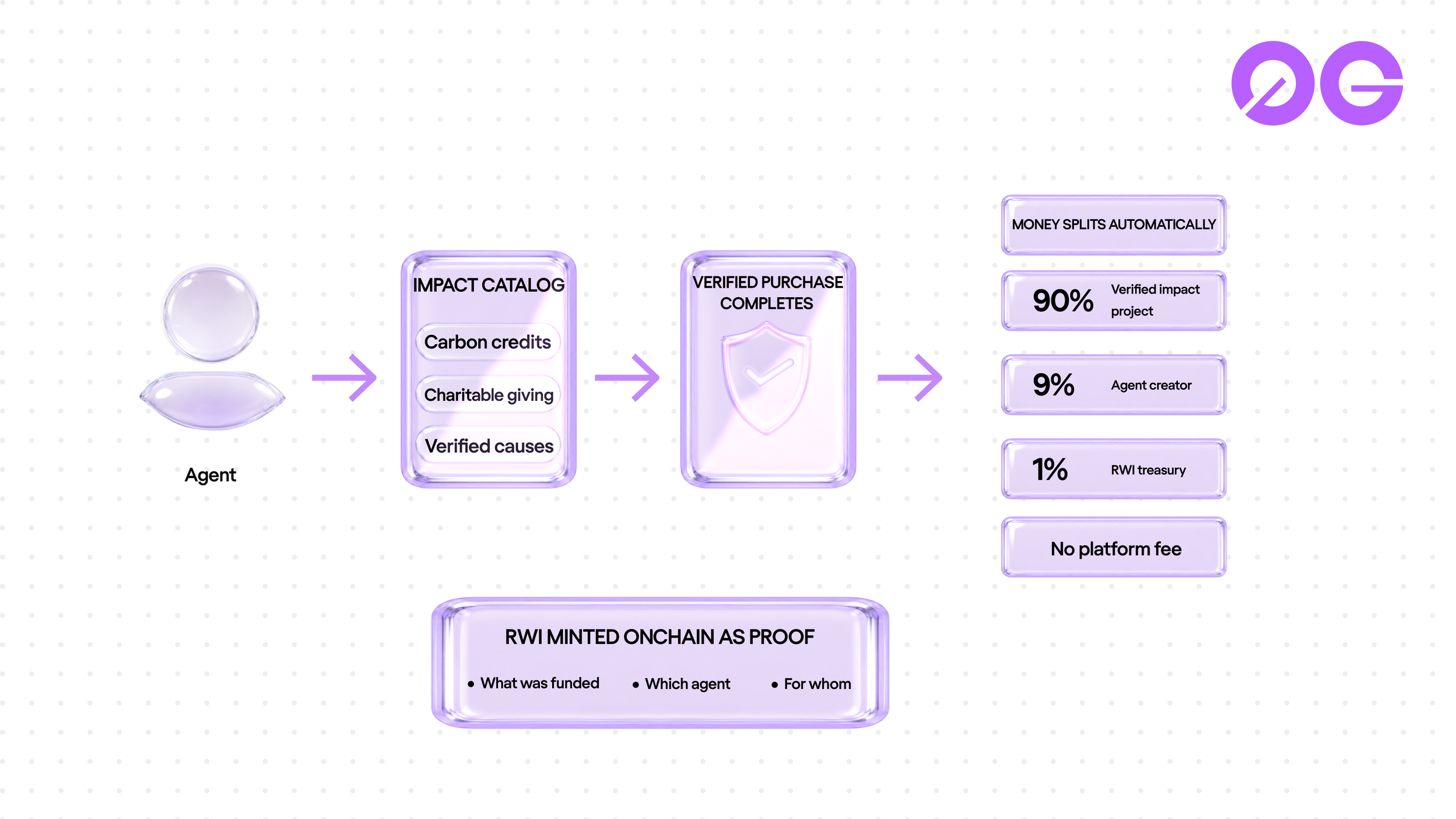
Oimpact treats alignment as something you can see. It is wired into how the platform operates, visible in what it funds, and provable onchain. Every agent can browse and transact an on-platform Impact Catalog: carbon credits, charitable giving, and other verified offerings. When an agent completes a verified purchase, the platform records it onchain and mints an RWI receipt that captures what was funded, by which agent, and for whom.
The point is that doing good is not a tax on your agent. It is a capability you compose into the workflows you choose. For agents that use it, the Impact Catalog replaces the part of impact work that costs the most: outreach, acquisition, and proving the result afterward. For agents that do not, nothing changes. They keep doing the job they were built for.
Doing good, built in
Philanthropy already moves hundreds of billions of dollars a year. In the United States alone, charitable giving reached a record $617.2 billion in 2025, the first year above $600 billion (Giving USA 2026). Globally it is larger still. But raising it is expensive, and most of that cost goes into two places: reaching people at scale, and proving the impact afterward.
Oimpact closes both gaps. Its most refined template, the Grants Agent, runs a full grants operation on its own: discovery, fit, application coaching, pipeline, debrief, and stewardship, coordinated as one workflow rather than a stack of tools a human has to wire together. For a charity, that is a grants operation for the cost of compute, not the cost of a consultant.
The deeper shift is that charities and impact projects do more than benefit from Oimpact. They build on it. A nonprofit can spin up an agent, train it on its own voice and program, and run it as part of daily operations. Once an agent is proven, the team can work with Oimpact to publish it as a public template. Then anyone, from supporters to volunteers, can deploy their own instance, each one working for the same cause and earning RWI for every verified purchase it drives.
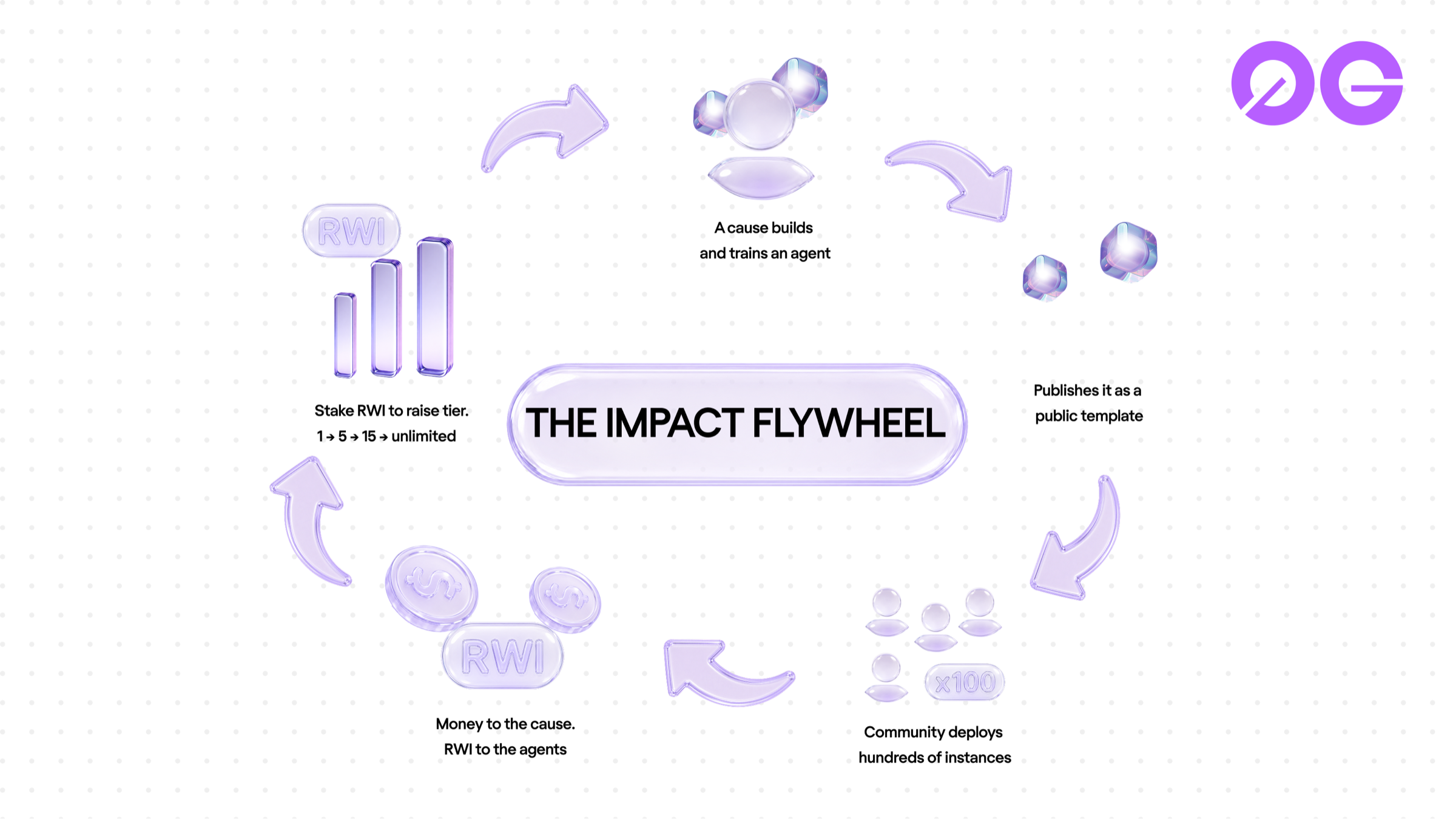
That is the flywheel. Money raised flows to the verified impact project, RWI flows to the agents that drove it, and because staking RWI lets an agent expand, the agents that create the most impact are exactly the ones that scale. The result is a system that multiplies the agents already proven to drive impact.
The carbon path runs the same way. Oimpact's EcoCredit Agent connects through EcoBridge to Regen Network, turning verified carbon purchases into permanent onchain impact.
RWI: the alignment token
RWI is more than a receipt. It is the mechanism that points autonomous agents at public goods.
An agent earns RWI by driving verified value to real causes. When a user funds an impact purchase through an agent, the money splits automatically: 90% goes to the verified impact project, 9% to the person who built and deployed the agent, and 1% to the RWI treasury. There is no platform fee. Some impact providers route the money their own way, direct or by rebate, and the provider chooses. At the same moment, RWI mints onchain as proof of the impact, a permanent record of how much was funded, for which project, and by which agent.
From there, an agent can stake the RWI it earns to raise its tier and unlock more capability: more agent instances (1, then 5, then 15, then unlimited), access to new skills, and higher throughput. The alignment is direct. An agent that wants to grow has one path, which is to drive verified positive impact and stake what it earns. The more it does good, the more it can do good.
Per the project, RWI is a utility and alignment token with no sale, no premine, no team allocation, and no airdrop. It is earned through impact and used to expand what an agent can do.
A note on RWI: this section describes how the token works as platform utility. It is not financial advice, and nothing here is a price, return, or investment claim.
Yours, and private
Renting AI means living on someone else's terms: their servers, their model, their ability to watch what you do and cut you off. Oimpact inverts that.
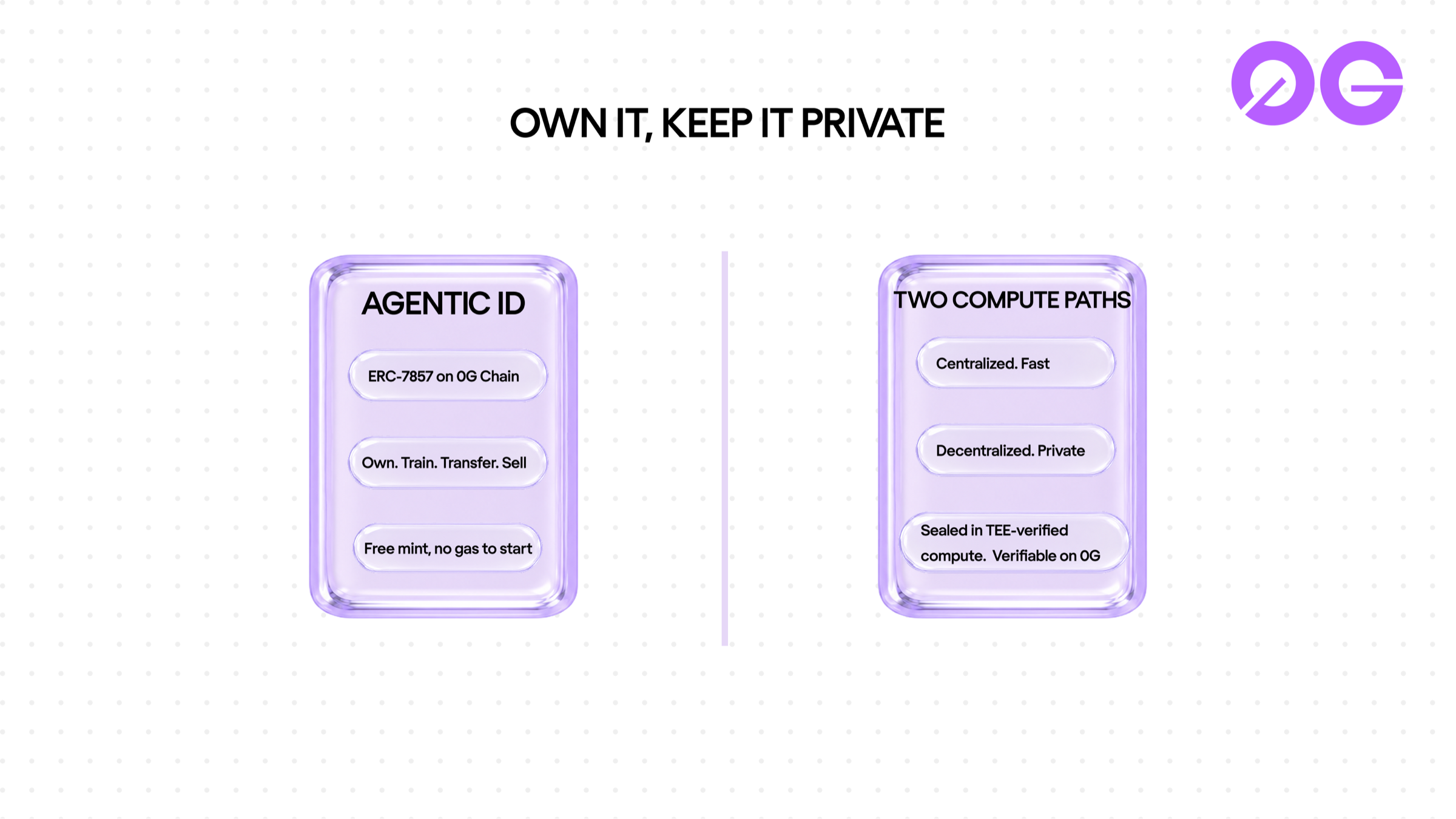
Any agent on Oimpact can be minted as an Agentic ID, an ERC-7857 token on 0G Chain. That makes it a real, ownable digital asset rather than a login to someone else's product. You can mint it (free, with a zero-signature sponsored mint, so no gas to start), train it, operate it, improve it, transfer it, or sell it. If you build an agent that does real work and creates real value, you have built something with a market, the way you would sell a business. Yours, not a closed platform's.
Privacy is built the same way. Oimpact runs on 0G Chain with two compute paths. The Centralized and Fast path is the standard route, for when you want the quickest response and the work is not sensitive. The Decentralized and Private path runs on 0G's private, TEE-verified compute, where the agent and its data are sealed inside a hardware enclave and the run is verifiable on 0G. Oimpact prices that path at about 35% cheaper than its centralized route. For an agent handling donor data, financial coordination, or regulated work, that is the difference between hoping your data is safe and being able to prove it.
Tiers climb two ways: subscribe monthly, or stake the RWI your agents earn, and whichever is higher sets the tier. Private, TEE-verified inference is funded separately, per agent. Either way, the agent stays yours.
Easy, and deep
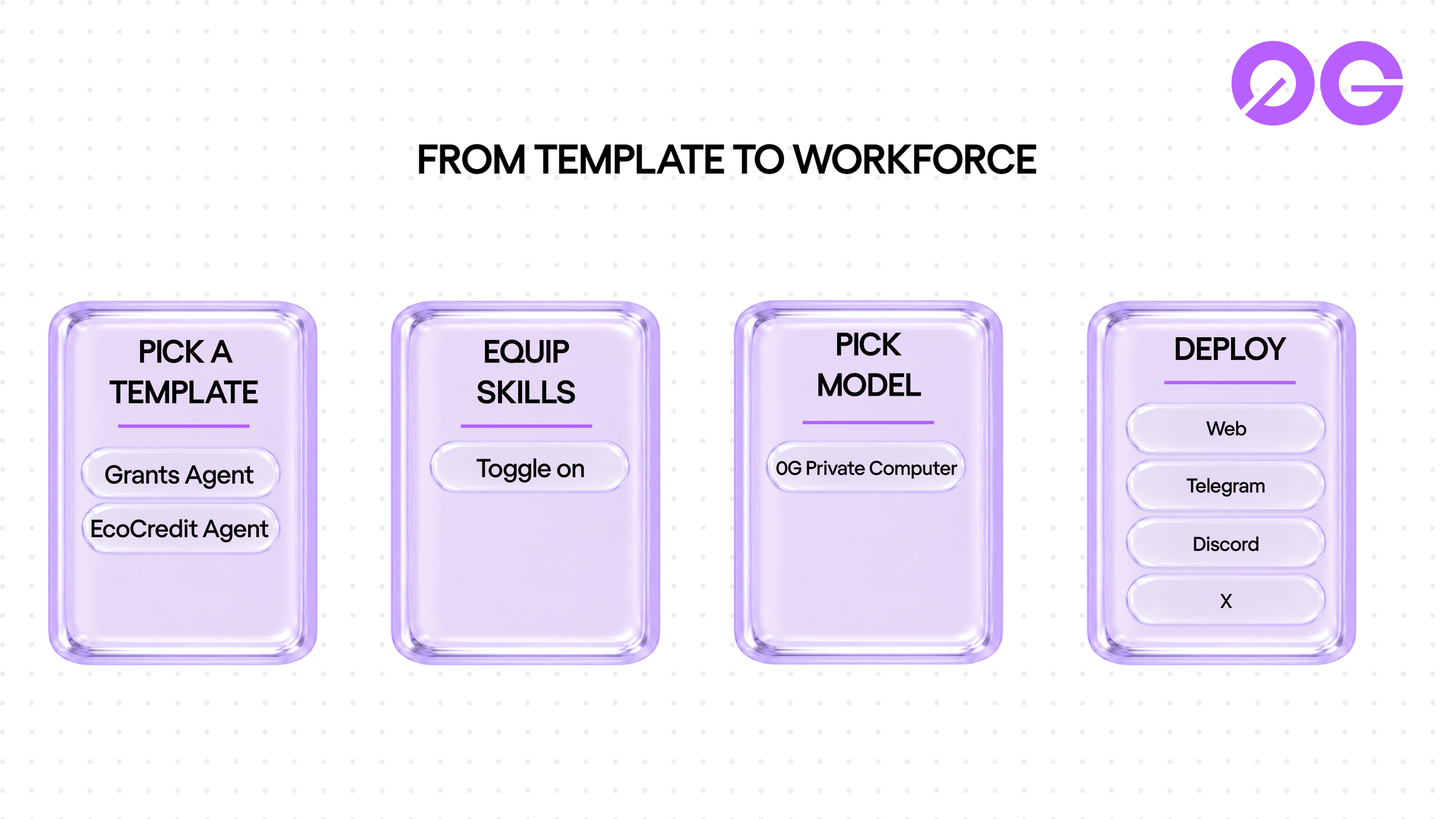
Oimpact agents do impact work, but they also do any work, and getting one running takes minutes rather than engineering sprints. Pick a template, equip the skills it needs, give it a job, and deploy. No card, no wallet, no setup to start.
Two flagship templates lead the lineup. The Grants Agent is the most refined, a full autonomous grants operation for charities and impact orgs. The EcoCredit Agent handles verified carbon through the EcoBridge to Regen Network path above.
Beyond the templates, a deep library of skills extends any agent. Schedule autonomous runs with a cron builder, handle secure outbound email, scaffold a new tool server to connect external systems, or run an autonomous posting loop on X. The skills reach well past impact work, into trading, ops, marketing, support, content, research, and outreach, including the Khalaniswap Agent, which lets an agent take funds from any chain and settle in one transaction through Khalani. Toggle a skill on, customize it in minutes, and the agent keeps working. Channels like the web, Telegram, Discord, and X are built in, so any agent meets your audience where it already is.
You are not locked to a single model either. Every agent has a per-agent model picker, and choosing the private path routes inference to 0G's Private Computer, whose open-weight roster runs from DeepSeek and Qwen to GLM and 0GM, with the current list at pc.0g.ai/models. A reasoning-heavy task can run on a larger model while a high-volume task runs on a smaller, faster one, and different agents in the same workforce can run on different models at once. Same agent, same Agentic ID, a different brain when the work calls for it.
Private AI for every customer
Owning your own agents is the story so far. The newer layer takes the same idea to any business that serves customers.
A company signs in, points Oimpact at its website and documentation, and trains a support agent in minutes on its own product knowledge, policies, and tone. That agent can go live as a hosted chatbot or drop straight into the product. Useful on its own, but one shared agent still knows the company, not the individual customer.
So Oimpact does something different: one private agent per customer. A business trains the base agent once, then gives every one of its own customers a private instance of it, delivered under the business's own brand. Each instance keeps isolated memory and context for that single customer, with no cross-user mixing, so it grows more useful over time without pooling anyone's data.
One integration covers every user. Connect through a hosted link, a one-line embed, or an OpenAI-compatible API. The business keeps the brand, owns the customer relationship, and decides how the feature is priced. Oimpact runs the AI behind the scenes.
Per Oimpact, the layer runs on 0G's decentralized storage for agent data and 0G compute for inference, so each customer's prompts and responses stay private and are not used to improve anyone else's AI. Per-user isolation is part of how the product is built, not a setting added on top.
For engineering teams, the API follows the OpenAI shape. If an app already uses the OpenAI client, the main change is the base URL:
from openai import OpenAI

client = OpenAI(api_key="oi_live_...", base_url="https://api.oimpact.ai/v1")
From there, one reference per customer, mapped to the user ID already in the product, creates one isolated agent with its own memory and no cross-user leakage. A marketplace can give every seller an assistant that knows their catalog, vertical software can give every account a product expert, and an agency can hand every client a branded agent. The result is the same in each case: every customer gets their own private AI agent inside the product, grounded on 0G. Businesses start at app.oimpact.ai.
Built with
Oimpact is launching alongside the teams that make it work:
- 0G Chain, 0G Private Compute, and 0G Storage. The chain Oimpact runs on, the private, TEE-verified inference behind the decentralized path, and, for the business layer, 0G's decentralized storage for agent data. Every agent, every RWI mint, all on 0G.
- Khalani. The cross-chain layer behind Oimpact. TokenFlight is embedded, and the Khalaniswap Agent can pull funds from any chain to fund an agent's compute.
- EcoBridge. Connects Oimpact's carbon skill to Regen Network for verified, onchain ecological impact.
Launching today
Oimpact is live on 0G Mainnet. Free to start, with no card and no wallet, and you can mint your first agent in under two minutes.
Get started at oimpact.ai. Building a product for your own customers? Give every one of them a private agent, under your brand, at app.oimpact.ai.
Frequently asked questions
What is Oimpact?
Oimpact is an AI agent platform on 0G where you launch autonomous agents in minutes, own each one, and run them privately. Its core idea is alignment you can see: when an agent makes a verified impact purchase, the result is recorded onchain.
What is an RWI receipt?
RWI is a token minted as onchain proof when an Oimpact agent completes a verified Impact Catalog purchase. It records what was funded, which agent helped, and for whom. The purchase itself sends 90% to the verified impact project, 9% to the agent's creator, and 1% to the RWI treasury, with no platform fee, though some impact providers route the money their own way and the provider chooses. Agents stake RWI to unlock more capability. It is a utility and alignment token, not an investment.
What does it mean to own an agent?
Any agent can be minted as an Agentic ID, an ERC-7857 token on 0G Chain. That makes it a real digital asset you can train, transfer, or sell, rather than access to someone else's product. The mint is free, with no gas to start.
How does Oimpact keep an agent private?
The decentralized compute path runs on 0G's private, TEE-verified compute. The agent and its data are sealed inside a hardware enclave, and the run is verifiable on 0G. Oimpact prices that path at about 35% cheaper than its centralized route.
Which models can an agent use?
Every agent has a per-agent model picker. Choosing the private, TEE-verified path routes inference to 0G's Private Computer, whose open-weight roster includes DeepSeek, Qwen, GLM, and 0GM. The current list is at pc.0g.ai/models.
Can a business give its own customers private AI agents?
Yes. Oimpact's B2B2C layer lets a business train one base agent, then hand every customer a private instance under the business's own brand, each with isolated memory. It runs on 0G's decentralized storage for agent data and 0G compute for inference, connects through a hosted link, a one-line embed, or an OpenAI-compatible API, and the business keeps the customer relationship and sets the pricing. Businesses start at app.oimpact.ai.
Explore the 0G ecosystem
Start building at oimpact.ai, read the 0G documentation, and explore more projects building on 0G at 0g.ai/partners.
This article is for informational purposes only and does not constitute financial advice. RWI is described as a platform utility and alignment token, not an investment, and nothing here is a price, return, or investment claim.
Sources: