173 projects have shipped on 0G across 10 events, and the Builder Hub at build.0g.ai got the rebuild it needed to fit them. By the time the finishers at ETHGlobal Cannes 2026 were submitting projects that lean on 0G Compute, 0G Storage, and ERC-7857 Agentic ID inside a single repo, the old hub layout was the bottleneck. The redesign is the response.
build.0g.ai is now the single workspace for builders shipping onchain AI on 0G. The piece that lands first is Ask AI, a doc-grounded assistant running on 0G Compute that answers questions straight from the documentation, with citations. Around it sit the stack pages, SDKs, tools, tutorials, and a showcase that scales.
What build.0g.ai is
build.0g.ai is the dev-facing entry point. Separate from 0g.ai (the corporate site) and docs.0g.ai (the reference manual), it carries the tagline that anchors the rest of the hub: "Build the next generation of onchain AI with the fastest AI L1."
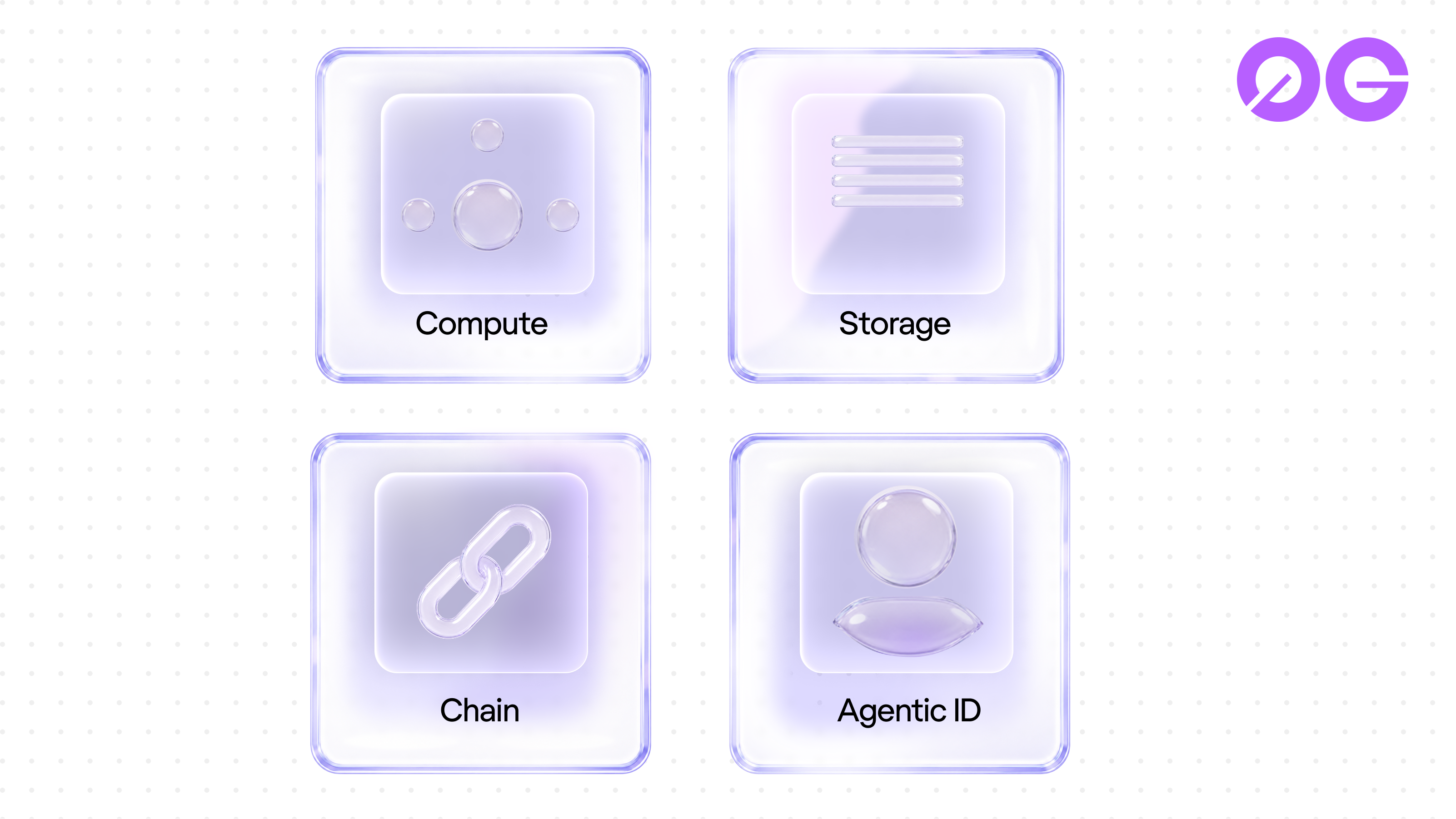
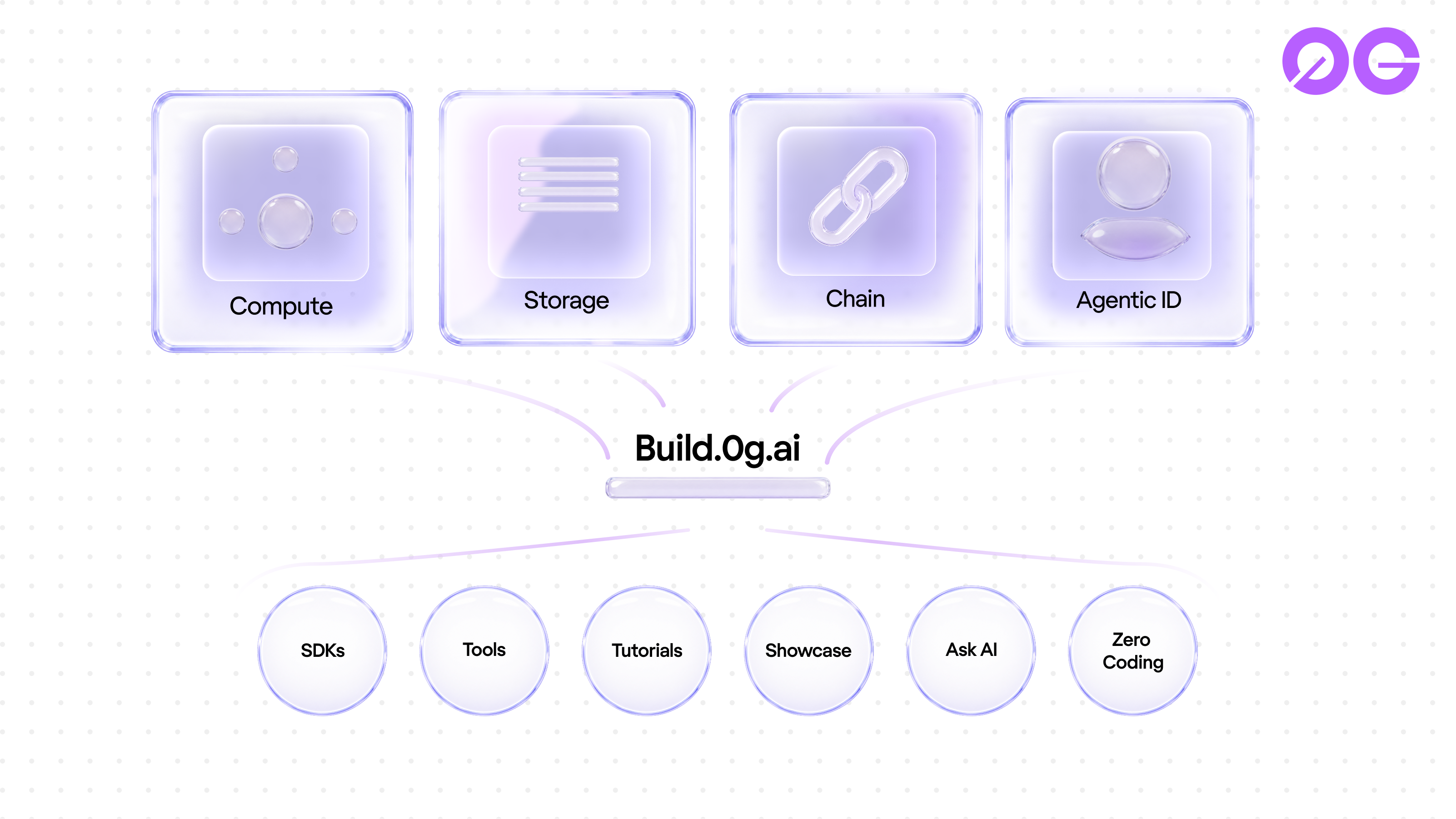
Four stack pages cover the products a builder is actually combining inside one application:
- Compute for decentralized AI inference, priced for builders.
- Storage for fast decentralized storage for AI workloads.
- Chain for an EVM-compatible Layer 1 tuned for AI apps.
- Agentic ID for onchain identity for AI agents, on the ERC-7857 standard.
Beneath the stack pages sit the resource sections: Tools, SDKs, Tutorials, Showcase, and the Zero Coding path for builders who want to ship without writing code from scratch. Each one is a place to build from.
Ask AI is live
Ask AI opens a chat against 0G's full documentation directly inside build.0g.ai, so a builder can resolve a stuck question without breaking flow to dig through another tab. Every answer comes back with citations, so you can trace it to the source instead of trusting a black box.
Ask AI runs on GLM-5.1 served through 0G Compute. The hub answers builder questions on the same decentralized inference layer it documents, so the assistant is itself a working example of the stack. It complements docs.0g.ai rather than replacing it: the docs stay the reference, Ask AI is the fast path to the right page.
Why the hub got rebuilt
The old layout did not scale. The showcase outgrew its 3-column grid the moment the project count crossed 100. The Mandarin builder community grew fast enough that a translate button was no longer optional. The visual language drifted across pages because the original templates were not designed for the surface area the team kept adding.
So the work happened in passes, between mid-April and the start of May:
- The showcase was restructured to fit hundreds of projects without breaking layout, and four new events were added in the same pass.
- The product and stack pages were rebuilt with an editorial-grade visual language, after the team got reader feedback at ETHCC.
- Light mode shipped. Semantic color tokens, no-flash theme switching, and a six-phase color migration so the hub holds up whether you read in a dark booth or under a desk lamp.
- Internationalization shipped with an English to Mandarin toggle in beta across the full site, with full-width punctuation and CJK letter-spacing polish in flight.
- The SDK package namespace was cleaned up under
@0gfoundation/, so npm-installed builders pull from a coherent root instead of legacy package names. - The showcase now carries multi-select filters by category and event, plus toggles to surface Zero Coded entries and Winners.
What is live now
A walking tour, in the order a new builder usually moves through.
The four stack pages. Compute, Storage, Chain, and Agentic ID. Agentic ID has a live testnet contract at 0x2700F6A3e505402C9daB154C5c6ab9cAEC98EF1F, a six-step quickstart with copy-pasteable code, and three self-contained example repos.
SDKs and starter kits. 16 packages on the SDKs page. 6 official SDKs covering TypeScript, Compute (TS), DA (Rust), Storage (Rust and Go), and 0G Memory for AI coding assistants. 7 official starter kits including a deployment scripts pack in Solidity (Hardhat plus Foundry) and a fine-tuning example. 3 community packages tagged separately under "not officially maintained by 0G Labs," so builders can tell what is supported.
Tools. 8 tools split across Essential (testnet faucet, Storage Scan, Chain Scan for mainnet and testnet, Private Computer), Infrastructure (QuickNode and Ankr RPC), and Community (OpenAdapter for 70+ open-source AI models).
Tutorials. 29 videos on the tutorials page: 14 Dev Guides plus recorded partner sessions, ranging from 4 to 75 minutes. A Mandarin tutorial series is included.
Zero Coding path. Three entry points for builders who do not want to write code from scratch: 0G App, Claude Code, and Cursor. AI Context Documentation, the 0G Compute Skills package for Claude Code, the 0G Agent Skills package (14 skills, 6 architecture references, 3 IDE setups), the 0G Code to Coin MCP server, and 6 prompt templates that builders copy and adapt.
What builders ship on 0G
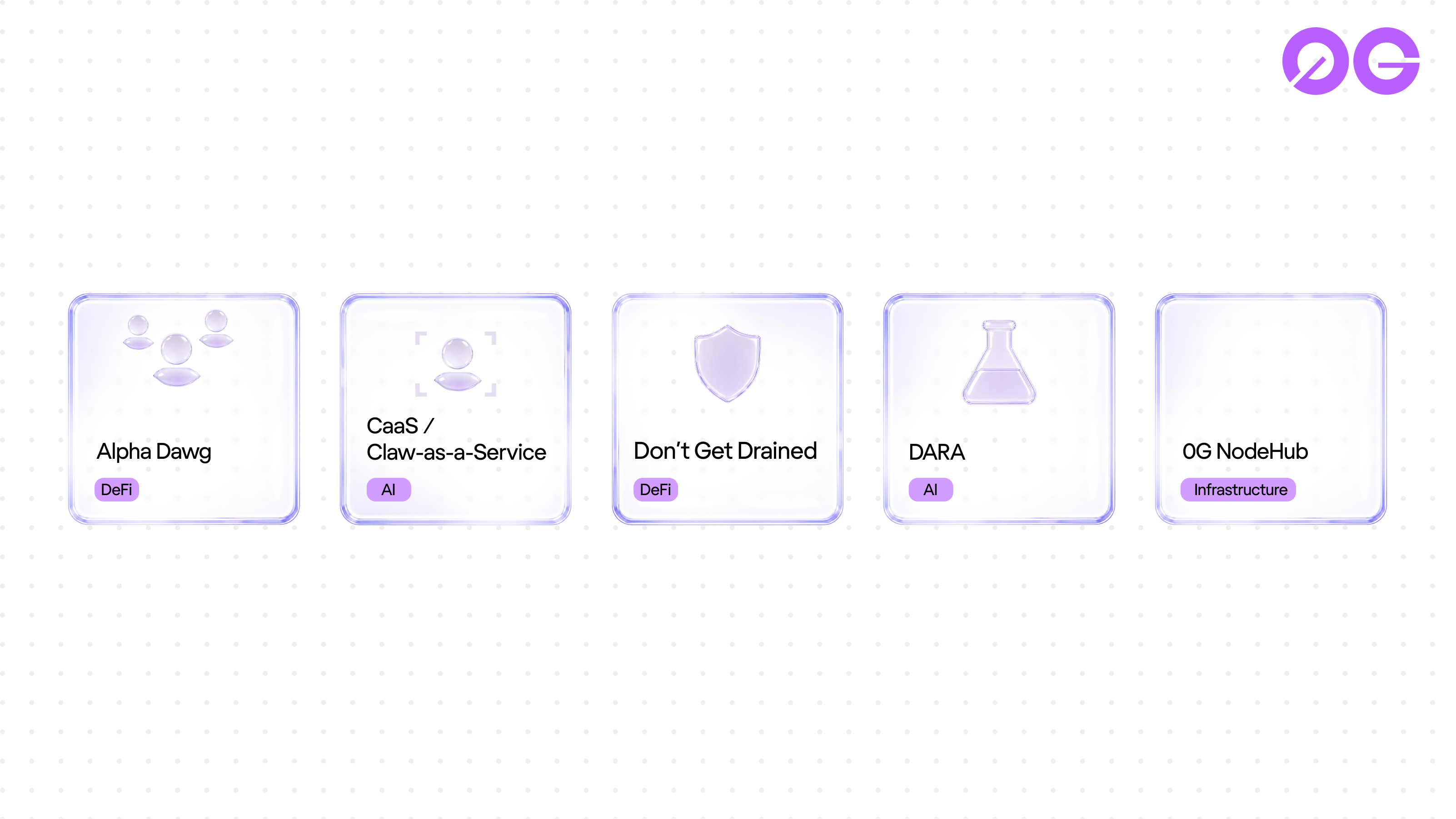
The showcase collects 173 projects shipped across 10 past events, built so the next builder can see what a real 0G app looks like before writing a line. Here are five, picked to show the range, not to crown winners.
Alpha Dawg (ETHGlobal Cannes 2026) is an autonomous multi-agent swarm. It hires specialists via nanopayments, runs TEE-sealed adversarial debate on 0G Compute, and stores a verifiable cycle DAG on 0G Storage. It leans on three 0G products at once, the kind of build the old hub could not stage in two clicks.
CaaS, short for Claw-as-a-Service (ETHGlobal Cannes 2026), deploys World ID-verified autonomous agents as ERC-7857 Agentic IDs on 0G Chain, with 0G Storage memory and WLD-powered x402 micropayments. It reaches across 0G Chain, Storage, and ERC-7857 in a single agent.
Don't Get Drained (ETHGlobal Cannes 2026) is an agentic firewall marketplace where security researchers publish AI guard agents that review DeFi transactions before execution. It uses 0G Compute and 0G Storage with Safe Guard integration, and lands the 0G stack in a defensive-security context most agent demos avoid.
DARA, the Decentralized AI Research Assistant (Akindo Wavehack Buildathon) puts verifiable onchain AI behind scientific discovery work. It reads like the work of a team building for the long haul.
0G NodeHub (Akindo Wavehack Buildathon) is managed node infrastructure for 0G with enterprise-grade AWS integration and one-click deploy. Other builders use it as a dependency, infrastructure that sits under their apps.
The full list lives at build.0g.ai/showcase.
The numbers behind the showcase
The showcase header carries the math:
- 173 projects shipped on 0G
- 63 winners across the showcase
- 25 zero-coded entries on the no-code path
- 10 events represented, from ETHGlobal Cannes 2026 back to Devcon Developer Challenge 2024
- 14 categories used by the community: DeFi, AI and Agents, Oracle, Content, Marketplace, Tools, Identity, Health, Gaming, Infrastructure, Storage, Education, Analytics, Social
Events represented include ETHGlobal Cannes 2026, Zero Coding Cannes 2026, Zero Coding ETHDenver 2026, ETHGlobal Buenos Aires 2025, ETHGlobal New Delhi 2025, ETHGlobal Cannes 2025, ETHGlobal Trifecta 2025, TinTinLand AI Agent Hackathon, Akindo Wavehack Buildathon, and Devcon Developer Challenge 2024.
The hub keeps pace with the activity now.
For builders who want to start: the stack pages are the front door, the SDKs page is the second click, and Ask AI is there the moment you get stuck.
Frequently asked questions
What is build.0g.ai?
The 0G Builder Hub. The dev-facing entry point separate from 0g.ai and docs.0g.ai. It carries the four stack pages (Compute, Storage, Chain, Agentic ID), 16 SDKs, starter kits, and community packages, 8 tools, 29 tutorials, Ask AI, and the showcase of 173 projects shipped on 0G.
Where do I start if I am building an AI agent on 0G?
The Agentic ID quickstart at build.0g.ai/agentic-id. Six steps with copy-pasteable code. The spec is ERC-7857.
Which SDKs are official, and which are community?
13 official packages live under the @0gfoundation/ namespace: 6 SDKs and 7 starter kits. 3 community packages are clearly tagged "not officially maintained by 0G Labs." The site separates them so builders can tell what is supported.
What is the 0G showcase?
The showcase at build.0g.ai/showcase is a gallery of 173 projects already shipped on 0G across 10 past events, filterable by category and event, with winners marked. It is built as a reference for new builders, not a list of upcoming hackathons.
Is 0G open to community contributions?
Yes. Three community SDK packages are listed in the SDKs section, tagged separately from the official ones. Public 0G repos accept pull requests against documented contribution paths.
What is 0G?
0G is the trust layer for AI. It combines private compute, encrypted storage, and an AI-native EVM L1 chain in one stack where AI work, from inference to agent actions, is verified and audited.
Where can I get 0G?
get.0g.ai is the interactive guide on how and where to acquire 0G tokens, with options for developers, investors, and ecosystem participants.
Where can I build on 0G?
Start at build.0g.ai for docs, starter kits, and the latest SDK. Visit 0g.ai/partners to browse the projects already shipping on the network.
Build on 0G
- Start building: build.0g.ai
- Read the docs: docs.0g.ai
- See the showcase: build.0g.ai/showcase
- Follow @0G_labs for what ships next
Sources:
- build.0g.ai (live site walk, May 2026)
- build.0g.ai/showcase (project list, 173 projects)
- build.0g.ai/sdks (SDK and starter kit list, 16 packages)
- build.0g.ai/tutorials (29 videos)
- Geth to Reth validator migration
- 0G Private Computer now accepts credit cards