The execution client that powered Ethereum since 2015 is hitting its limits. 0G just replaced it.
Go-Ethereum (Geth) has been the default execution client for EVM chains since Ethereum launched. It works. It has been battle-tested across thousands of nodes for nearly a decade.
But "works" and "keeps up" are different things.
As on-chain workloads have grown beyond simple token transfers into AI inference settlement, high-frequency agent transactions, and real-time data availability, the execution layer has become the constraint. Geth was built in Go, a language that trades raw performance for developer convenience. That trade-off shows up in production: unpredictable memory spikes from garbage collection, slower sync times, and block execution latency that compounds under load.
0G is not the first network to notice. Base has fully deprecated Geth in favor of Reth. Optimism is ending op-geth support by May 2026. The industry is converging on a single answer: Reth.
What Reth actually changes
Reth is a Rust-based Ethereum execution client originally built by Paradigm. Rust does not have a garbage collector. Memory is managed at compile time, which eliminates the unpredictable pauses that Go introduces during high-throughput workloads.
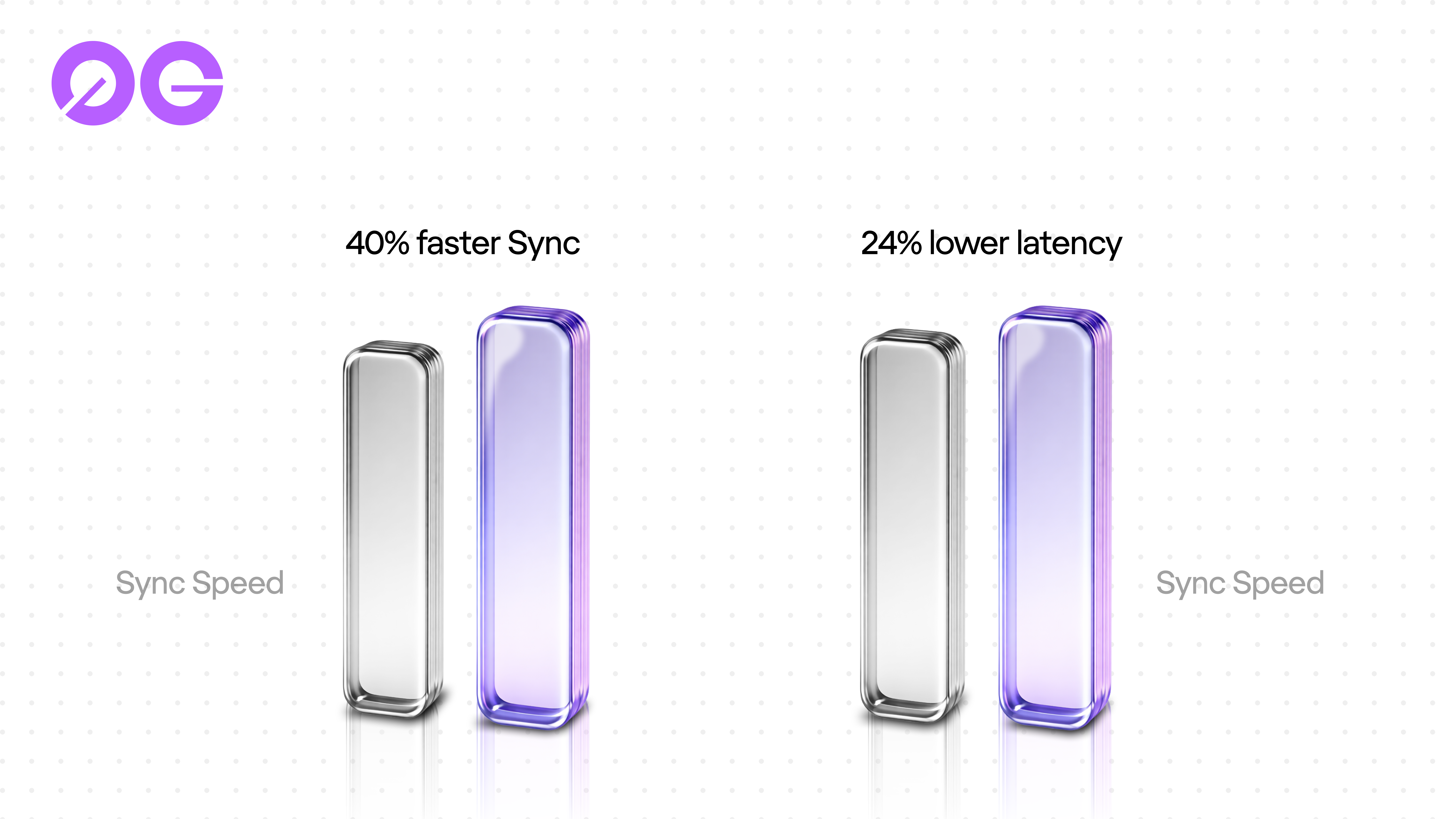
The performance difference is measurable. BNB Chain ran production benchmarks comparing both clients on live infrastructure:
| Metric | Geth | Reth | Improvement |
|---|---|---|---|
| Sync speed | Baseline | 40% faster | Sync time |
| Block execution latency (p50) | 25.3ms | 19.1ms | 24% lower |
| Memory behavior | GC spikes | Predictable | No pauses |
| Architecture | Monolithic | Modular | Independent optimization |
Source: BNB Chain production benchmarks, 2025.
The numbers go deeper than sync speed. Reth’s RPC layer handles up to 16,000 requests per second with latency as low as 1 millisecond under load (Chainstack benchmarks, 2025). For Debug and Trace APIs, Reth reaches over 500 RPS, roughly 10x faster than the Erigon client and far ahead of Geth.
Storage is another factor. Geth archive nodes were projected to hit the 30TB NVMe limit by mid-2025 (Paradigm, April 2024). Reth’s disk usage grows an order of magnitude slower, keeping archive clients viable through the 2030s at current growth rates.
Beyond raw speed, Reth’s modular design lets teams optimize storage, EVM execution, and networking layers independently. For a network like 0G that handles AI workloads alongside standard blockchain operations, this modularity is the difference between waiting for upstream changes and building what you need now.
How the migration happened
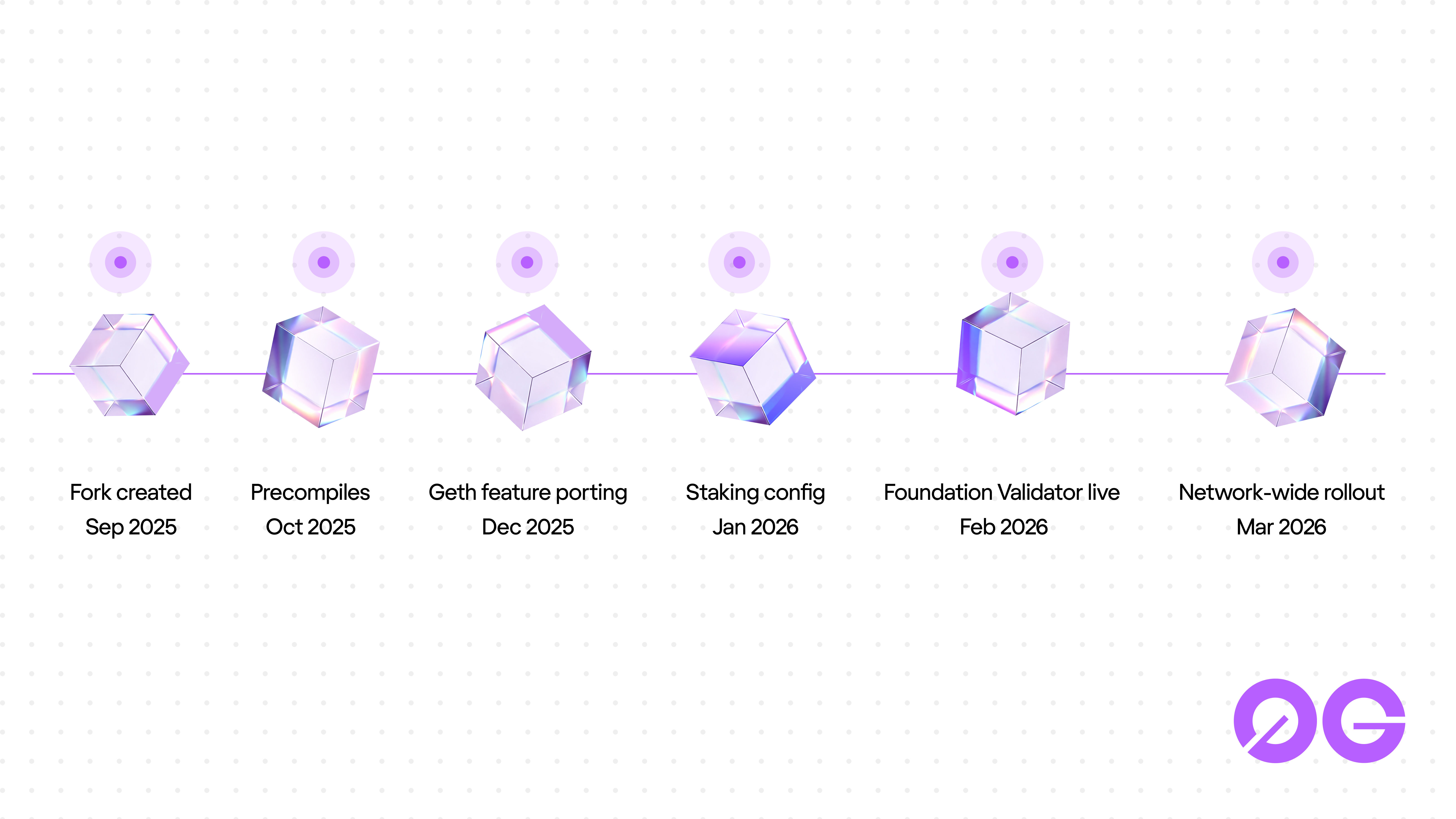
The 0G engineering team did not flip a switch. The 0g-reth repository has been under active development since September 2025, the same month Aristotle Mainnet launched.
Reth is not a clean replacement for Geth out of the box. 0G runs custom execution logic that does not exist in vanilla Reth: stateful precompiles for on-chain operations, modified gas pricing based on block usage, and staking activation configurations tied to the 0G consensus layer. All of this had to be ported.
The commit history tells the story. In September and October 2025, the team built the precompile layer and fixed block time validation. By December, a series of commits labeled "pick geth features" systematically moved 0G-specific logic into the Reth codebase. January brought staking activation configs for mainnet. In February, a fix for consensus layer timeout handling on large payloads landed days before the Foundation Validator went live.
Over six months: 27 custom commits, 12 merged pull requests, all built on top of Paradigm’s 11,500+ commit base.
The Foundation Validator (Validator 0) was the first to upgrade, completing the migration in February 2026. After running in production without issues, the upgrade was announced for network-wide rollout on March 13, 2026.
“Geth served us well, but as on-chain AI workloads scale, the execution layer becomes the bottleneck. Reth’s Rust-based architecture gives us the memory efficiency, parallel processing, and modular extensibility we need to stay ahead of that curve. This isn’t just a client swap. It’s rebuilding the foundation for what comes next.” — Ming Wu, CTO of 0G Labs
The network right now
Live data from explorer.0g.ai as of March 2026:
| Metric | Value |
|---|---|
| Active validators | 57 (of 70 total) |
| Total delegation | 390,461,631 0G |
| Total delegators | 2,085 |
| Blocks produced | 27.5 million+ |
| Average block time | 0.8 seconds |
| Contracts deployed | 5,300+ |
| Daily active accounts | 3,500+ |
| Total accounts | 345,492 |
The upgraded Foundation Validator now sits at #2 by delegation with 67.7 million 0G tokens staked, confirming that delegators trust the new infrastructure.
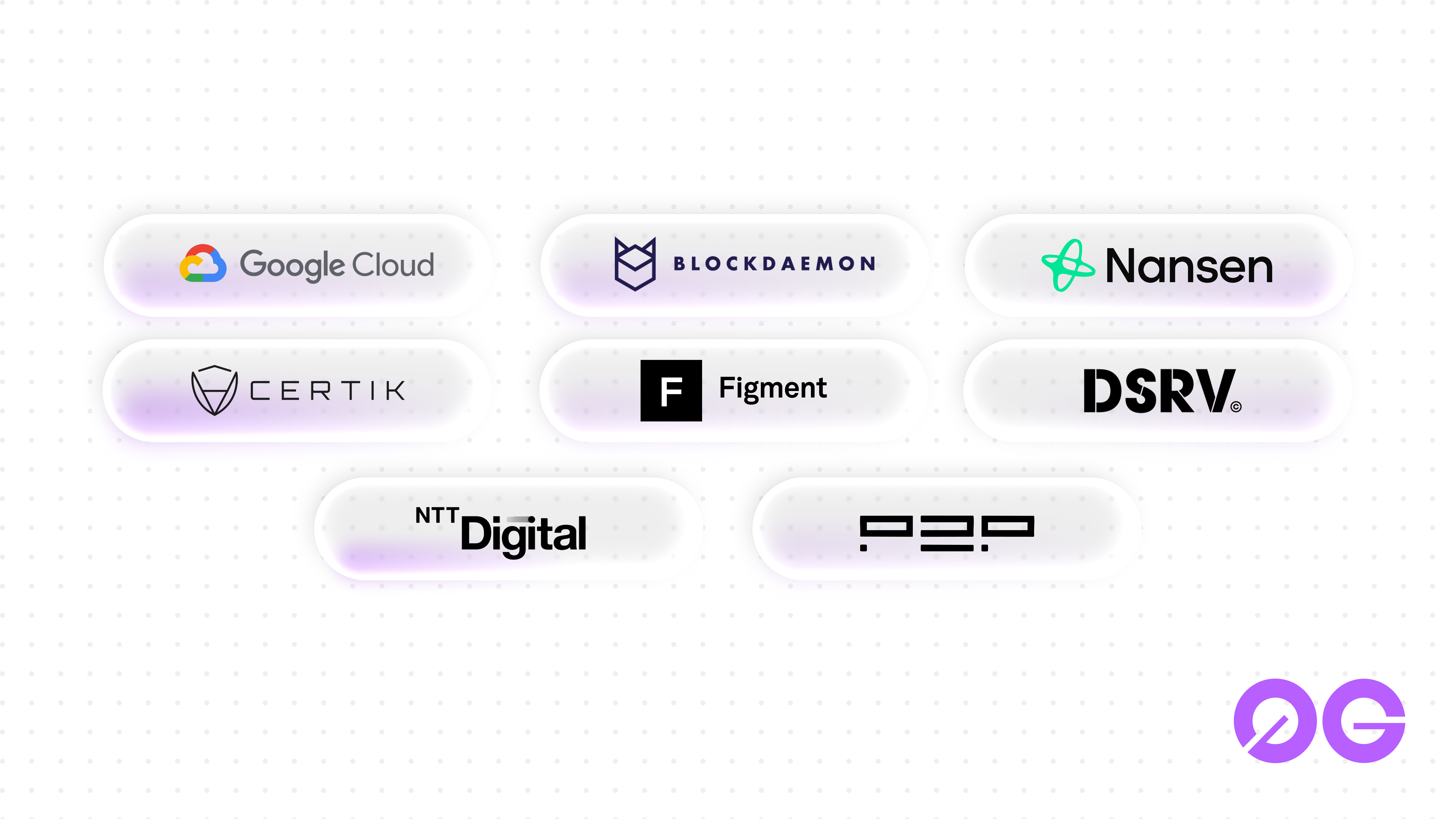
The validator set includes institutional operators from traditional finance and Web3 infrastructure: Google Cloud, CertiK, NTT Digital, Blockdaemon, Figment, P2P.org, DSRV, Nansen, InfStones, Hex Trust, and HT Digital Assets.
What this means for the 0G stack
The Reth migration is one piece of a broader infrastructure push announced alongside two other upgrades: Sealed Inference for cryptographically private AI compute, and GLM-5 integration as the highest-ranked open-source model running on decentralized infrastructure.
Together, these reinforce 0G’s full-stack architecture:
- 0G Chain: EVM-compatible Layer 1 for AI workloads, now powered by Reth
- 0G Compute: Decentralized GPU marketplace with TEE-verified inference
- 0G Storage: Up to 2 GB/s throughput
- 0G DA: 50,000x faster and 100x cheaper than Ethereum’s data availability layer
The project is backed by $290 million in funding from Hack VC, Delphi Digital, OKX Ventures, Samsung Next, Animoca Brands, and Bankless Ventures, with over 100 ecosystem partners including Chainlink, Google Cloud, Alibaba Cloud, and Coinbase Wallet.
For validators, the Reth upgrade means faster node synchronization, lower hardware costs, and better uptime during peak loads. New validators joining the network sync to the chain tip faster, reducing the barrier to participation. Existing operators benefit from more predictable resource usage, which directly translates to lower cloud computing bills.
For developers building on 0G Chain, the impact is a more responsive execution layer. AI inference results that need on-chain settlement, agent-to-agent transactions that happen in bursts, and data availability proofs that must process in real time all benefit from lower latency and higher throughput at the execution layer.
The migration also positions 0G to absorb improvements from the upstream Reth project without maintaining a divergent Go codebase. As Paradigm and the broader Reth contributor community ship performance improvements, 0G can merge them directly.
Frequently asked questions
What is Reth?
Reth is a Rust-based Ethereum execution client built by Paradigm. It replaces Geth (Go-Ethereum) with better performance, lower memory usage, and a modular architecture that allows chains to optimize individual components independently.
Do I need to do anything as a delegator?
If you are still staking with the original Validator 0 (address 0x712a...cf3b4), you should undelegate and re-delegate to the new Foundation Validator (0xec85...f17d) or any other active validator. All other delegators are unaffected.
How does this affect 0G’s performance?
BNB Chain production benchmarks show Reth delivers 40% faster sync and 24% lower block execution latency compared to Geth. 0G validators now benefit from these improvements across the network.
Which other chains use Reth?
Base has fully deprecated Geth in favor of Reth. Optimism is ending op-geth support by May 2026. Reth has become the standard execution client for high-throughput EVM chains.
Is the migration complete?
The Foundation Validator completed its upgrade in February 2026 and has been running on Reth in production since. The network-wide rollout to all validators was announced in March 2026 and is ongoing. All validator operators can follow the upgrade path documented in the 0G GitHub repository.
Build on 0G
- Explore the validator set: explorer.0g.ai
- Read the migration guide: Foundation Validator Migration
- Start building: 0G Documentation
- Follow @0G_labs for updates
Sources
- BNB Chain: BSC Reth Client (production benchmarks)
- Business Insider: 0G Geth-to-Reth Migration (press coverage)
- explorer.0g.ai (live network data, March 2026)
- 0G Foundation: Validator Migration (delegator guide)
- Paradigm: Reth Performance (architecture deep-dive)
- GitHub: 0g-reth (source code)