The biggest onboarding blocker is gone. Top up with a credit card, settled in 0G underneath.
When 0G Private Computer launched on April 27, the launch included one caveat: fiat support coming soon. The product was live, the API worked, every inference ran inside a TEE, but funding still meant the same four-step loop. Buy 0G on an exchange, withdraw to a wallet, send to the funding contract, wait for confirmation, then make your first request.
For a Web2 developer evaluating decentralized inference for the first time, that loop was enough to close the tab.
Today that loop goes away. 0G Private Computer (pc.0g.ai) now accepts credit and debit card deposits through 0G Pay, the full payment layer behind the product, powered by Khalani.
What 0G Pay is
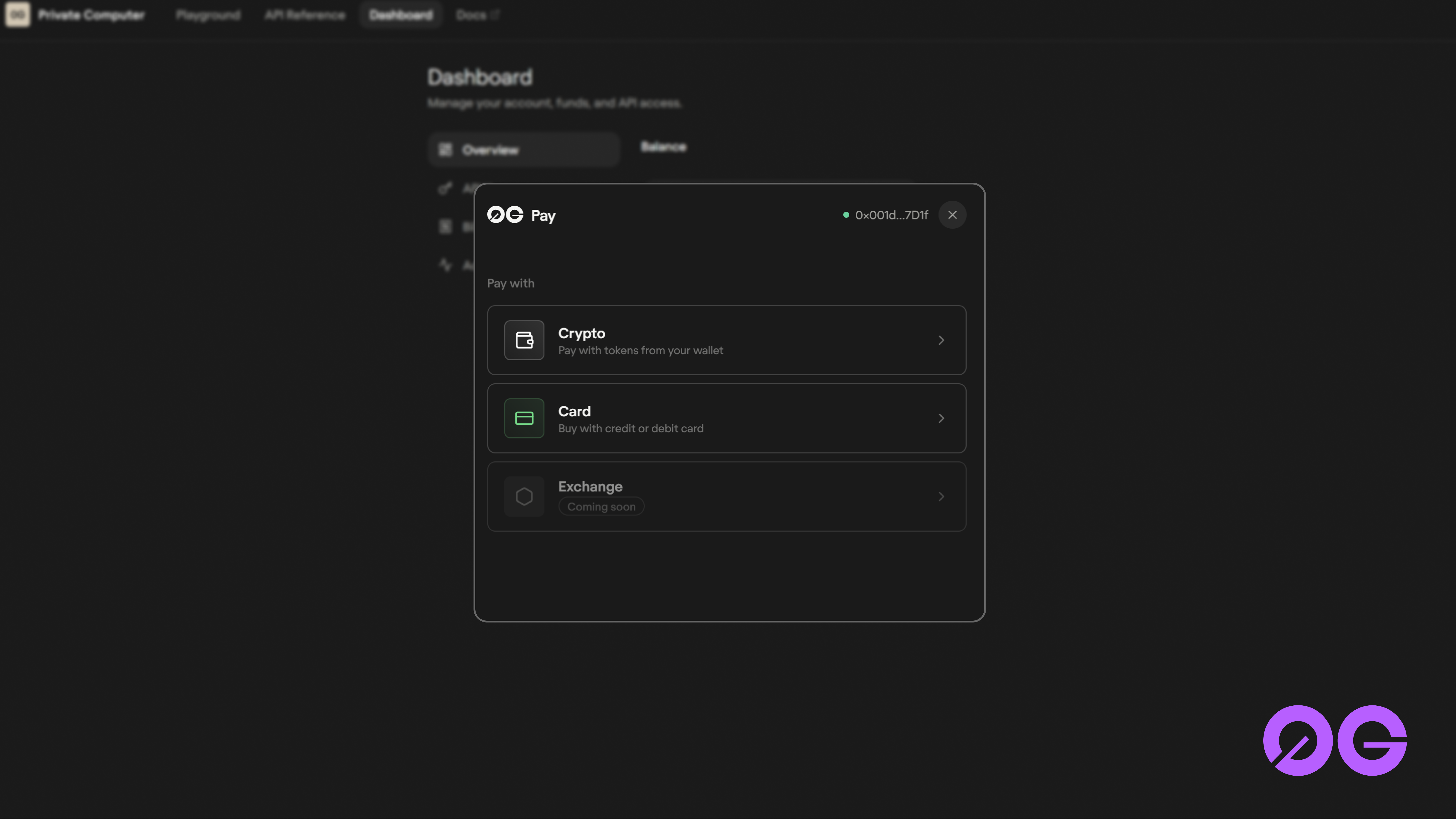
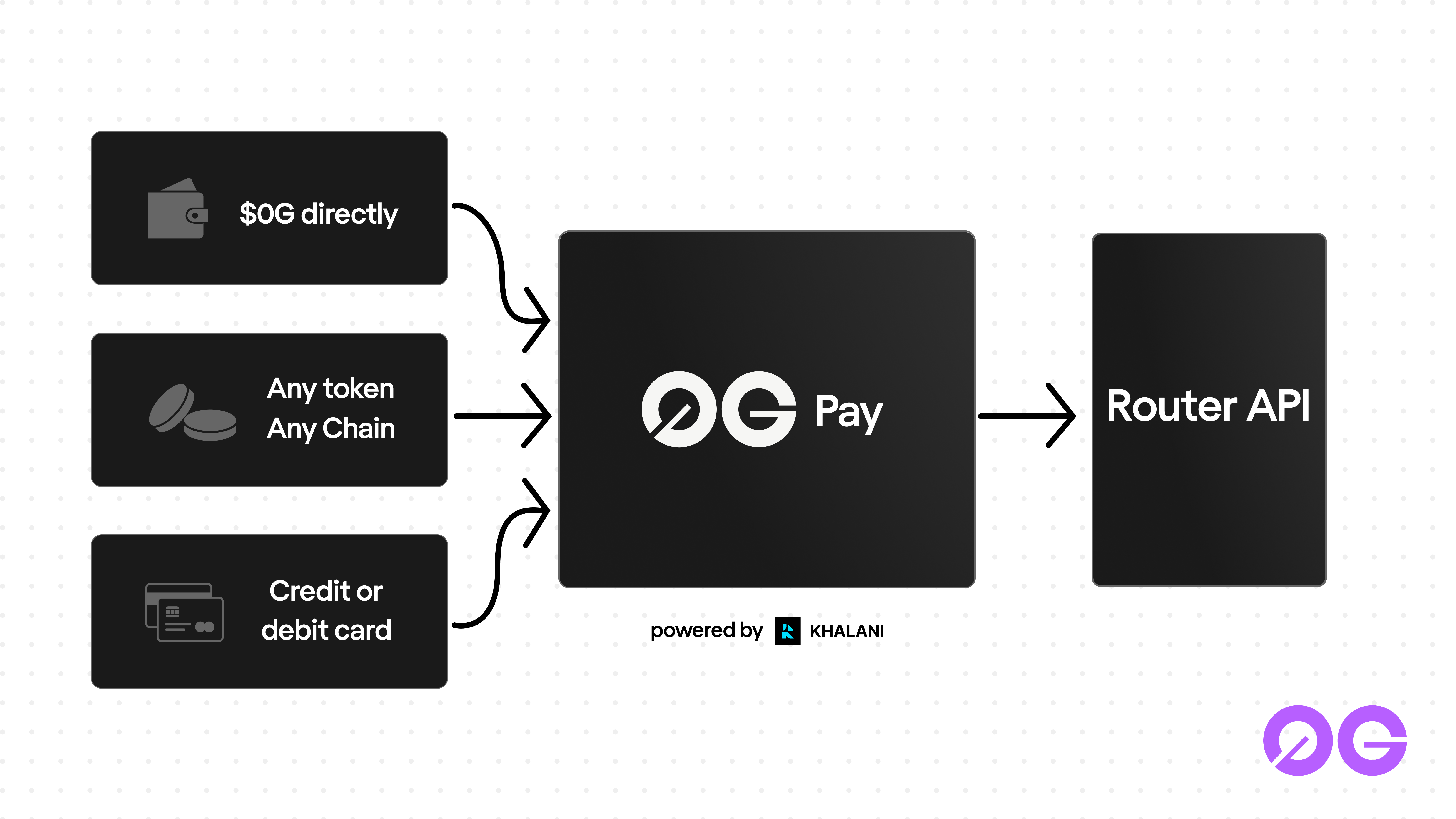
0G Pay is the payment layer 0G Private Computer's dashboard opens when you click Deposit, and the layer the Router API draws from on every inference call. It is one balance with three ways to fund it.
The three deposit paths land in the same place:
- 0G directly. Send 0G from a wallet you already hold.
- Any token from any chain. USDC on Ethereum, USDT on BSC, ETH on Optimism, and so on. Khalani's solver network routes the conversion in the background, the funded position arrives as 0G.
- Credit or debit card, paid in USD. The 0G Pay window takes the card, runs KYC and authorization, credits land in the same compute balance.
Whichever path the user picks, the same balance is what the API meters against. One ledger, three funding rails, no per-provider sub-account work.
What changes for the user
Nothing changes for anyone already paying in 0G. Wallets still work, top-ups still work, the Router endpoint at router-api.0g.ai/v1 still terminates against the same TEE-verified providers. The API contract has not moved a byte.
What changes is who can get to the first inference.
A Web2 developer or end user can now:
- Log in via socials. The dashboard creates a wallet automatically through Privy. No MetaMask install, no seed phrase to back up, no chain to switch.
- Top up with a credit or debit card. The 0G Pay window opens, the user pays in USD, credits land in the compute balance within minutes.
- Call the API. Same OpenAI-compatible endpoint, same TEE-attested response, same settlement in 0G token underneath.
The sequence shrinks from four crypto steps to one card swipe. For teams running an evaluation across providers, this is the difference between a same-afternoon pilot and a procurement conversation about acquiring tokens.
What 0G Pay does for builders
In a typical Web2 AI stack, billing, payment processing, and inference live on three different vendors. The developer holds a Stripe account that funds an internal credit ledger that the inference provider meters against. Reconciliation between those three is the developer's problem.
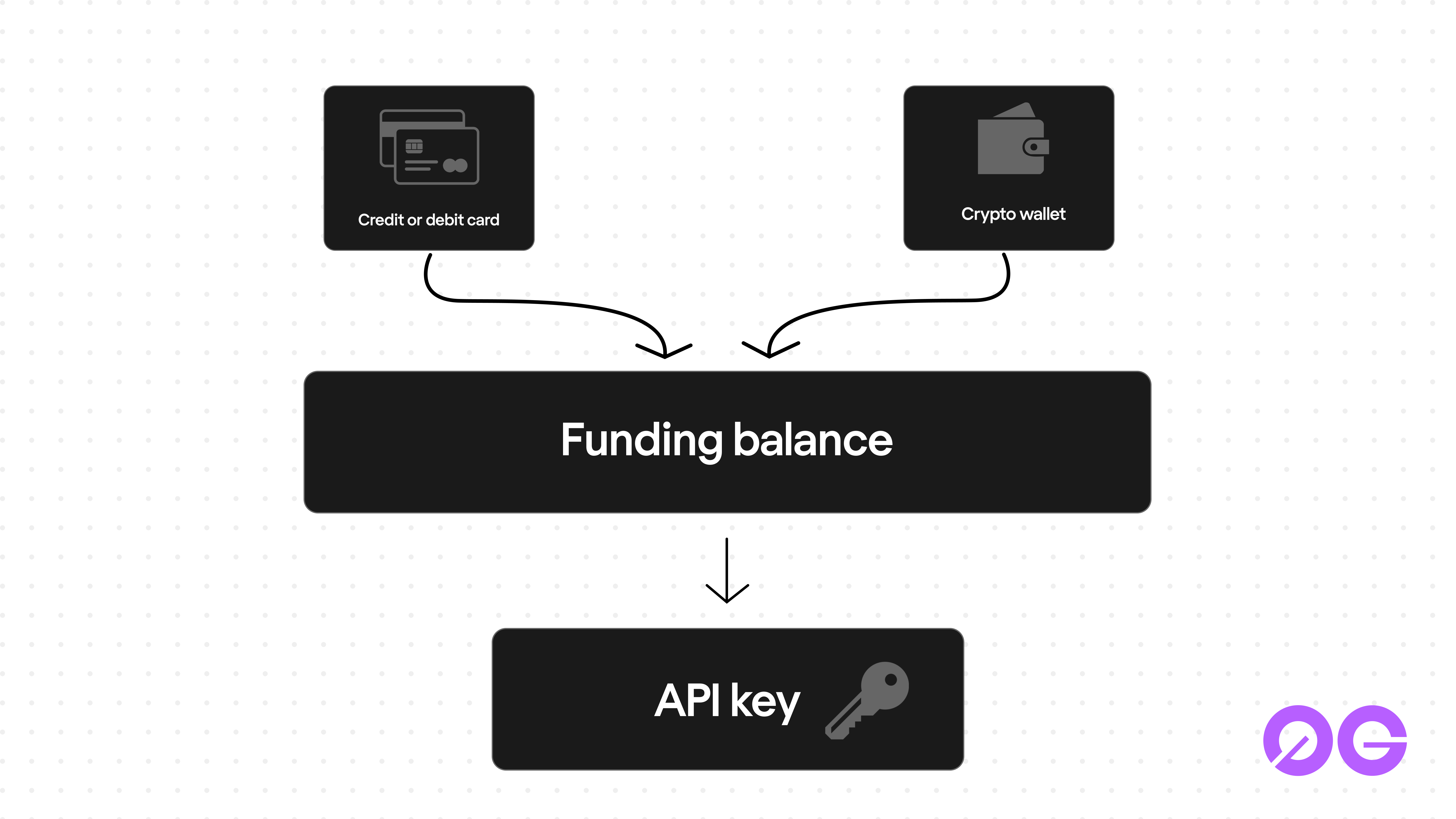
0G Pay collapses that into one layer. The same layer that records a card payment, a wallet top-up, or a cross-chain token swap is the layer the Router API draws from on every inference request. Metering is not a separate service that needs to agree with a different ledger. It is the same ledger.
For an agent stack, this has a downstream effect. An agent that bills end users by inference does not have to glue a payment processor to a compute provider through a custom backend. The funding instrument the user paid with, whether card, native 0G, or a token from any chain, already lives in the same account the agent's API key draws from. Onchain settlement happens once, at the funding step. After that, every inference call is a low-latency draw against an existing balance instead of a chain of cross-system writes.
Availability and limits
Card payments are available in supported regions. KYC requirements depend on the issuing country, and some regions may not be supported at launch.
Card details are not stored. The card flow accepts deposits between $5 and $3,000 per transaction, and credits typically land in the compute balance within minutes of confirmation.
A third funding option, Exchange (direct top-up from a centralized exchange), is also visible in the 0G Pay window with a "Coming soon" badge. It is not live at this launch but will surface in the same dashboard once it ships.
What stays the same
Every inference still runs inside an Intel TDX + NVIDIA H100 or H200 enclave. Every response carries an attestation. Settlement is still in 0G token. The fiat layer wraps the crypto rails. It does not replace them.
Where this fits in the 0G stack
Private Computer is the inference surface. 0G Pay is the funding seam between the user-facing surface and the chain. With three rails feeding the same balance, 0G Pay serves crypto-native users, multi-chain holders, and Web2-native onboarding paths through a single API key and a single ledger.
Beneath the seam: the 0G Compute Network routing requests to TEE-verified providers, 0G Chain on Reth handling settlement, 0G Storage holding state, and 0G DA carrying the data layer.
This release is one piece of the broader Private Computer rollout. The Apr 27 launch shipped the API, the Playground, the dashboard, and six TEE-verified models. Today closes the funding loop the launch flagged as "coming soon."
Frequently asked questions
Can I now pay for 0G Private Computer with a card?
Yes. Open pc.0g.ai, go to the dashboard, click Deposit, then pick Card in the 0G Pay window. The card payment goes through 0G Pay's Khalani-powered routing and credits land in your unified compute balance.
Which cards are supported?
Both credit and debit cards (Visa, Mastercard). KYC requirements depend on your issuing country. Card details are not stored on 0G's side.
Is there a minimum or maximum deposit?
Yes. Card top-ups accept between $5 and $3,000 per transaction. There is no minimum on the wallet flow.
How long does a card top-up take to land?
Within minutes. Once the conversion is confirmed, credits land in the unified compute balance the API has been drawing from since launch.
Can I fund 0G Pay with a token other than 0G?
Yes. The Crypto option in the 0G Pay window accepts any token from any chain that Khalani's solver network supports. The conversion happens in the background, and the funded position always lands in your compute balance as 0G.
What is the Exchange option in the 0G Pay window?
Coming soon. Exchange will let users top up directly from a centralized exchange, surfaced as a third funding path alongside Crypto and Card.
Does the wallet flow still work?
Yes. Existing 0G top-ups, wallet connections, and on-chain payments continue to work exactly as before. Card support is an additional way to fund, not a replacement.
Do I still need a Web3 wallet to use 0G Private Computer?
Not anymore. The dashboard now supports social login through Privy, which creates a wallet for you in the background. From there you can top up with a card and use the API. Crypto-native users can still connect an existing wallet directly.
What is 0G Pay?
0G Pay is the full payment layer behind 0G Private Computer. It accepts wallet top-ups, any token from any chain, and credit or debit cards. All three land in the same compute balance the Router API draws from on every inference request. 0G Pay is powered by Khalani.
Does the trust model change?
No. Every inference still runs inside a TEE-verified enclave (Intel TDX CPU + NVIDIA H100 or H200 GPU). Every response carries an attestation. Settlement is still in 0G token. Card payment changes how the balance gets funded, not what happens once a request hits the API.
Build on 0G
- Try it out: pc.0g.ai/dashboard/overview
- Get an API key: pc.0g.ai/dashboard/api-keys
- Read the docs: docs.0g.ai
- Follow @0G_labs for updates
0G Private Computer is the inference layer for AI agents. As of today, the funding layer accepts the same payment instrument the rest of the internet runs on, plus any token from any chain, plus the wallet flow that has worked since launch.
Sources
- 0G Private Computer launch (April 27, 2026)
- Khalani Network
- 0G Compute Network SDK
- Geth to Reth validator migration