AI models need storage that can keep up. Most decentralized options were built before that mattered.
Key takeaways
- Filecoin, Arweave, and 0G Storage each solve different problems. Filecoin optimizes for cost and capacity. Arweave optimizes for permanence. 0G optimizes for throughput and AI workloads.
- 0G Storage achieves 30+ MB/s throughput in mainnet production, compared to Filecoin's ~45-second retrieval latency and Arweave's block-size-limited uploads.
- 0G is the only decentralized storage protocol with native mutable data support through its dual-layer architecture (immutable Log Layer + mutable KV Layer).
- Cost depends on use case: Filecoin offers $0.19/TB/month for cold archival, Arweave charges ~$5-8/GB for permanent storage, and 0G runs at $11/TB/month for high-throughput Turbo storage.
- The choice is not which protocol is "best." It is which protocol fits the workload.
The storage problem AI created
Training a large language model produces hundreds of terabytes of data: model weights, gradient checkpoints, tokenized datasets, evaluation logs. Inference generates its own volume: prompt histories, output caches, retrieval-augmented generation indexes that update in real time.
This data does not sit still. It gets read, modified, versioned, and fed back into the next training run. It needs to move fast, and it needs to be accessible the moment a compute node asks for it.
Decentralized storage was not built for this. The first generation of protocols solved a different problem: how to store files without relying on Amazon or Google. They optimized for durability, cost, and censorship resistance. Those were the right goals in 2018.
But AI workloads in 2026 need something else. They need throughput measured in megabytes per second, not minutes per retrieval. They need mutable data stores that can handle key-value lookups alongside large sequential writes. And they need storage that talks to compute without an integration layer bolted on after the fact.
That gap between what AI demands and what decentralized storage provides is where this comparison starts.
Three approaches to decentralized storage
Arweave: pay once, store forever
Arweave launched in 2018 with a simple premise: pay a one-time fee and your data stays on the network permanently. The protocol uses an endowment model where roughly 95% of the storage fee goes into a reserve fund that pays miners over time, covering storage costs for 200+ years based on conservative projections of declining hardware costs.
The total data stored on Arweave sits at roughly 347 TiB as of early 2026. The network processes about 105 transactions per second and handles around 33 GiB in daily uploads. Its consensus mechanism, SPoRA (Succinct Proofs of Random Access), rewards miners who can quickly access randomly selected historical data chunks, which keeps the network incentivized to maintain full copies of the weave.
Arweave is ideal for records that should never change: legal documents, scientific datasets, cultural archives, NFT metadata. Its compute layer, AO, launched on mainnet in February 2025 and adds parallel processing on top of the storage layer.
The trade-off is throughput. Arweave transactions are capped at 10 MiB each, and the network uploads roughly 33 GiB per day. For AI workloads that involve hundreds of gigabytes moving in and out of storage, this creates a bottleneck.
Filecoin: the storage marketplace
Filecoin, live since October 2020, built something different: an open marketplace where storage providers compete on price and clients choose where their data lives. The network has committed roughly 23 EiB of capacity across 3,600+ storage providers globally, with about 3.0 EiB of active storage and 36% utilization.
Filecoin's verification system uses two proofs: Proof of Replication (proving data was uniquely encoded) and Proof of Spacetime (proving it stayed stored over time). The F3 upgrade in April 2025 reduced block finality from 7.5 hours to minutes, a major improvement for applications that need faster confirmation.
At ~$0.19/TB per month, Filecoin offers some of the cheapest decentralized storage available. The Filecoin Virtual Machine (FVM) adds programmability, and the Filecoin Onchain Cloud (FOC) initiative is working toward verifiable compute services.
The limitation is latency. Filecoin was designed around sealed sectors of 32 or 64 GiB, and the sealing process takes roughly 1.5 hours. Retrieval depends on whether the storage provider keeps an unsealed copy of your data. If they do, retrieval can happen in seconds. If they don't, you're looking at hours. Average retrieval latency in North America sits at around 45 seconds. For real-time AI inference or high-frequency data access, that is too slow.
0G Storage: built for AI workloads
0G Storage launched with Aristotle Mainnet in September 2025 as part of 0G's modular AI infrastructure. It was designed from the start to handle the read/write patterns that AI systems produce.
The architecture has two layers. The Log Layer handles large, append-only data: model weights, training datasets, event streams. The KV Layer sits on top and provides mutable key-value storage with millisecond-level read/write latency for structured data like user profiles, application state, and real-time indexes.
In mainnet production, 0G Storage achieves 30+ MB/s throughput (engineering confirmed, March 2026). The system is architected for up to 50 Gbps in aggregate throughput as the network scales. Verification uses PoRA (Proof of Random Access), where storage nodes must prove they hold randomly selected data segments.
The pricing model runs at $11/TB per month on the Turbo tier. Unlike Filecoin's provider-specific marketplace pricing or Arweave's one-time permanent fee, 0G uses a flow-based system where storage requests go through on-chain smart contracts on an EVM-compatible Layer 1.
Enterprise clients are already discussing migration of multi-terabyte datasets to mainnet.
How they compare
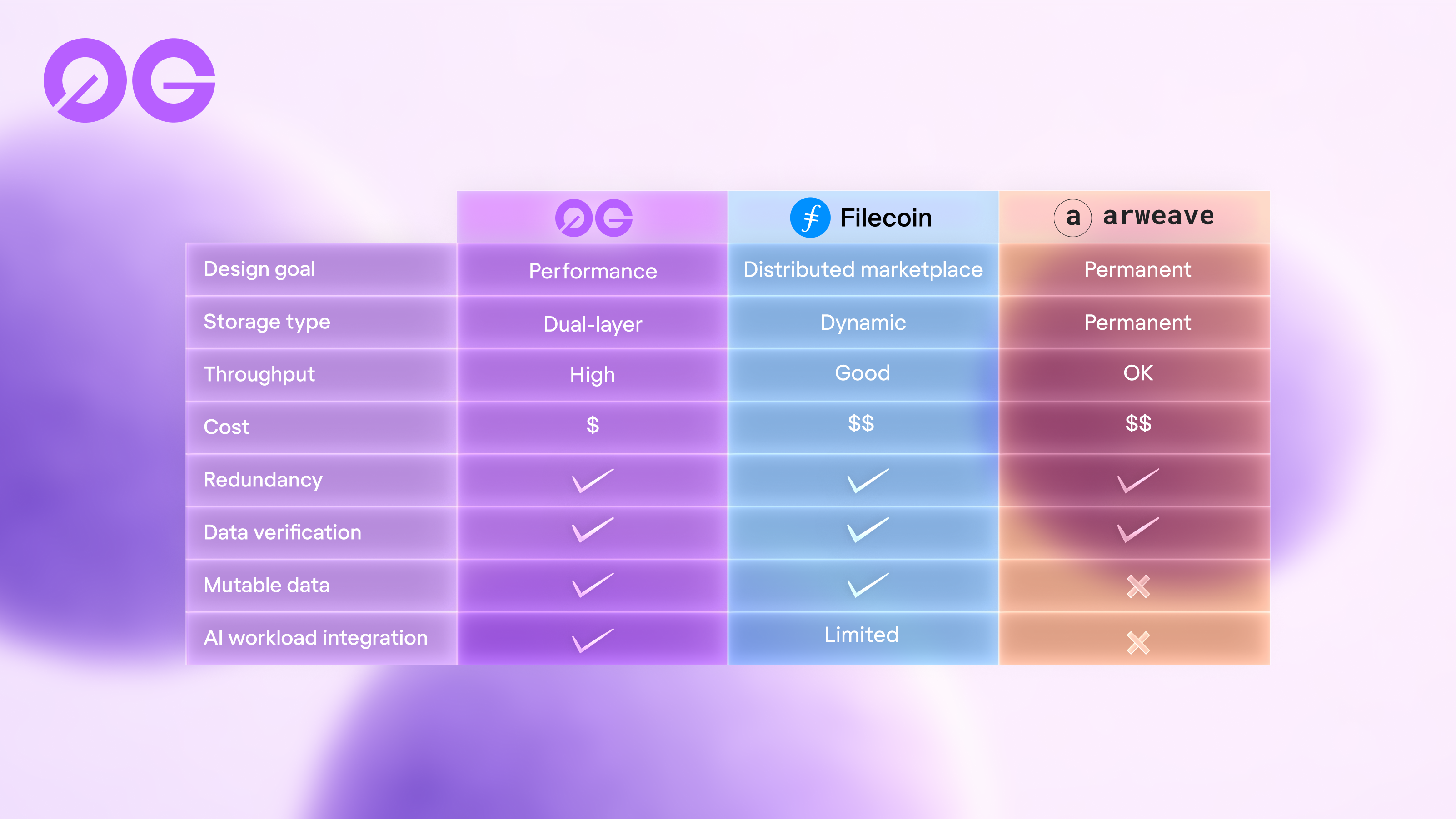
| Dimension | 0G Storage | Filecoin | Arweave |
|---|---|---|---|
| Design goal | AI-native real-time storage | General-purpose decentralized storage | Permanent immutable storage |
| Storage type | Mutable KV + Immutable Log | Contract-based sealed sectors | Write-once, stored forever |
| Throughput | 30+ MB/s mainnet measured | Retrieval latency ~45s (NA avg) | Limited by 10 MiB tx / ~33 GiB daily |
| Cost | $11/TB/month (Turbo) | ~$0.19/TB/month | ~$5-8/GB one-time permanent |
| Redundancy | User-configurable backup count | 3-6 node fixed replication | Network-wide incentivized replication |
| Data verification | PoRA random challenges | PoRep + PoSt | SPoRA (Proof of Access) |
| Mutable data | ✓ Native KV Layer support | ⚠ Adding via FVM | ✗ Immutable only |
| AI workload integration | Native (Storage + Compute + Chain) | Adding via FOC | Adding via AO |
Sources: 0G engineering (confirmed March 2026), Filecoin Starboard, Arweave ViewBlock, ArweaveFees, official documentation for each protocol.
Choosing the right tool
The comparison above does not have a single winner. Each protocol was built for a different job. Picking the right one depends on the workload.
| Use Case | Best Fit | Why |
|---|---|---|
| Cold archival, long-term backup, high-capacity storage | Filecoin ($0.19/TB/month) | Lowest recurring cost, flexible contract terms, 3,600+ global storage providers |
| Permanent records, immutable archives, NFT metadata | Arweave (~$5-8/GB one-time) | Pay once and never think about renewals. Data persists for 200+ years |
| AI training data, real-time inference, high-throughput mutable data | 0G Storage ($11/TB/month) | 30+ MB/s measured throughput, native KV mutable storage, integrated with compute layer |
A research lab archiving a finished dataset might use Arweave for its permanence guarantee. A data warehouse storing petabytes of cold backups might choose Filecoin for cost efficiency. An AI pipeline that needs to read model weights, update inference caches, and write results back to storage in real time is a natural fit for 0G.
These are not competing tools. They cover different parts of the storage stack.
What makes 0G Storage different
Four properties separate 0G Storage from protocols built in the previous generation.
1. Dual-layer architecture
Most decentralized storage supports one data model: immutable files. 0G Storage supports two. The Log Layer handles large sequential data (model weights, logs, datasets) with append-only immutability. The KV Layer adds mutable key-value storage on top, enabling real-time queries and state updates without rewriting entire files.
This means a single storage system can hold both the static training data and the dynamic inference state for an AI application. No external database required.
2. Measured throughput
0G Storage delivers 30+ MB/s in mainnet production as confirmed by the engineering team in March 2026. The architecture is designed for up to 50 Gbps aggregate throughput as more nodes join the network. For context, Filecoin's average retrieval latency in North America is around 45 seconds, and Arweave's daily upload volume is roughly 33 GiB. The throughput gap matters most for AI workloads where storage is in the critical path between compute jobs.
3. Configurable redundancy
Filecoin locks data into 3-6 node replication. Arweave relies on network-wide incentives to ensure copies exist. 0G lets users choose their own backup count based on their needs. A public dataset might need minimal redundancy. A production AI model might need higher guarantees. The choice is yours.
4. AI-native integration
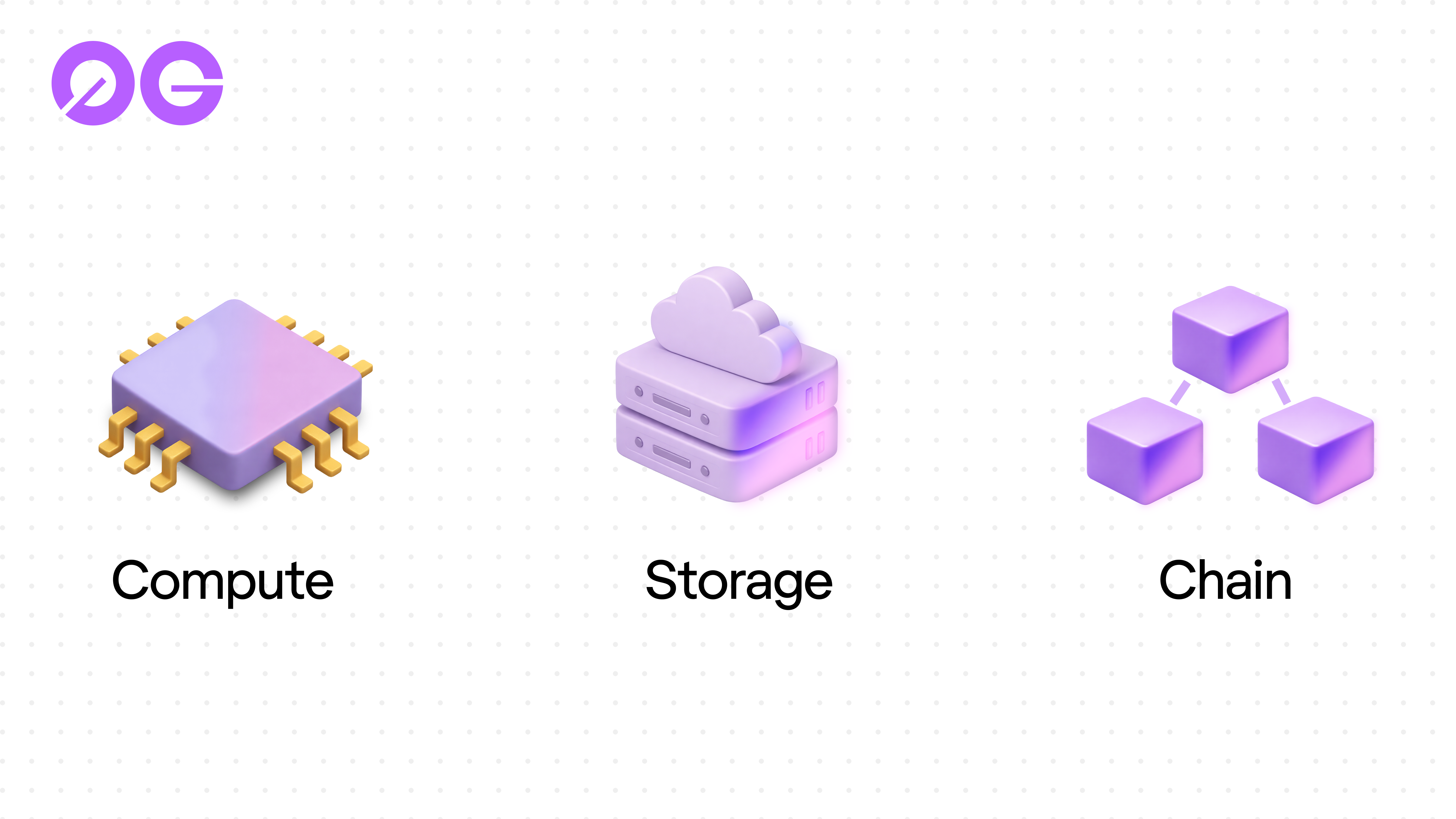
0G Storage is not a standalone service. It runs as part of a unified stack: 0G Chain (EVM-compatible Layer 1), 0G Compute (decentralized GPU marketplace), and 0G Storage. When a compute node needs model weights, it reads directly from storage on the same network. When inference results need to settle on-chain, the chain is right there. No bridging, no external API calls, no third-party integration layer.
Filecoin is adding compute capabilities through the Filecoin Onchain Cloud. Arweave has AO for parallel processing. Both are working toward similar goals, but those features are separate protocol additions rather than native parts of the storage architecture.
What this enables
With storage infrastructure that can handle AI-scale data at AI-scale speeds, the question shifts from "can we store this?" to "what can we build on top of it?"
Enterprise clients are already onboarding multi-terabyte datasets to 0G mainnet. The storage layer is one piece of a broader infrastructure that recently demonstrated a 107-billion parameter model trained across decentralized nodes using DiLoCoX with 357x better communication efficiency than traditional AllReduce.
Storage is the foundation. What gets built on that foundation is the next chapter.
Frequently asked questions
What is the main difference between 0G Storage, Filecoin, and Arweave?
Each protocol optimizes for a different priority. Filecoin optimizes for low-cost, large-scale archival storage. Arweave optimizes for permanent, immutable data preservation. 0G Storage optimizes for high-throughput, mutable storage designed around AI workload patterns.
Is 0G Storage trying to replace Filecoin or Arweave?
No. These protocols serve different use cases. Filecoin is well suited for cold storage and backups. Arweave is the right choice for data that must persist permanently. 0G fills a gap that neither covers: real-time, mutable, high-throughput storage for AI applications.
How does 0G Storage handle data verification?
0G uses Proof of Random Access (PoRA), where the network randomly challenges storage nodes to prove they hold specific data segments. Data is erasure-coded and distributed across nodes, and the network can tolerate up to 30% node failure while maintaining data availability.
What does "AI-native" mean in the context of storage?
It means the storage system was designed from the start to support AI workload patterns: high-throughput sequential reads (loading model weights), mutable key-value access (updating inference state), and direct integration with compute infrastructure (no separate bridging or API layer needed).
How mature is 0G Storage compared to Filecoin and Arweave?
Filecoin launched in October 2020 and Arweave launched in June 2018. 0G's Aristotle Mainnet went live in September 2025. While 0G is newer, its architecture was built with six years of lessons from earlier protocols. The network is in its early growth phase with enterprise clients actively onboarding data.
Explore 0G Storage
- Read the architecture deep-dive: 0G Storage: Built for the AI Era
- Run a storage node: Storage Node Documentation
- Start building: 0G Storage SDK
- Monitor the network: StorageScan
- Follow @0G_labs for updates
This article is for informational purposes only and does not constitute financial advice.
Sources:
- 0G Storage Documentation (architecture, PoRA, pricing)
- 0G Storage: Built for the AI Era (architecture overview)
- Aristotle Mainnet Launch (CryptoSlate, September 2025)
- Filecoin Starboard Dashboard (network capacity, utilization)
- Filecoin Documentation (proofs, sealing, FVM)
- Filecoin F3 Upgrade (finality improvement)
- Arweave ViewBlock (weave size, TPS, daily uploads)
- ArweaveFees (real-time pricing)
- AO Mainnet Launch (The Block, February 2025)
- 0G engineering team confirmations (throughput, cost, redundancy model; March 2026)