Frontier AI is shifting toward agents that run for hours, call thousands of tools, and carry multi-step work to completion on their own. The models built for that kind of work are closed-weight and API-only. You reach them by sending your prompts to a centralized endpoint and trusting, on policy alone, that they go where the provider says they go. For an autonomous agent handling proprietary code or user data, trust-by-policy is the weak link.
Qwen 3.7 Max, Alibaba's newest flagship and the model it calls "The Agent Frontier," is now live on 0G. You can query it at pc.0g.ai/models/qwen3.7-max, routed through a TeeTLS-attested transport layer to Alibaba Cloud Model Studio (Alibaba's Bailian platform), where the model runs. Every routing hop is provable onchain. Qwen powers the intelligence. 0G guarantees the trust.
It builds on the Alibaba Cloud x Qwen collaboration that brought the Qwen family onchain for AI agents. This post is about the newest model in that family, Qwen 3.7 Max, and how you reach it.
What's launching
Qwen 3.7 Max is reachable today on the 0G Private Computer. Router Mode (pc.0g.ai) selects a model for the workload automatically; Advanced Mode hands the choice to you. Either way the API surface is the 0G Router at https://router-api.0g.ai/v1, a single public endpoint that normalizes requests and responses across every model on the platform, in the OpenAI format.
| Specification | Value |
|---|---|
| Model | Qwen 3.7 Max (qwen3.7-max) |
| Developer | Alibaba, Qwen team |
| Positioning | "The Agent Frontier" |
| Context window | 1M tokens (verified live on 0G) |
| Max output | 65,536 tokens (per Alibaba model card) |
| Modality | Text in, text out |
| Reasoning | Extended thinking on by default |
| Tool use | Native function calling, OpenAI tools schema |
| License | Closed-weight, API-only |
| Hosted inference | Alibaba Cloud Model Studio |
| 0G verification | TeeTLS-attested routing |
The 0G deployment is the same app-sk-* key flow that already serves 0GM-1.0, DeepSeek V4 Pro, GLM-5, and Qwen 3.6-Plus. Qwen 3.7 Max joins that lineup as a separate, newer model; the partnership beat covered Qwen 3.6-Plus, this is the flagship above it.
The Agent Frontier
Alibaba built Qwen 3.7 Max for sustained, multi-step autonomous execution rather than single-turn chat. The headline strengths are agentic coding, office and workflow automation through MCP and multi-agent orchestration, and long-horizon tasks that span hundreds to thousands of steps. Extended thinking runs by default, so every response carries a reasoning trace. The context window is 1M tokens. Long context is now table stakes across the frontier, so it is a floor here, not the story.
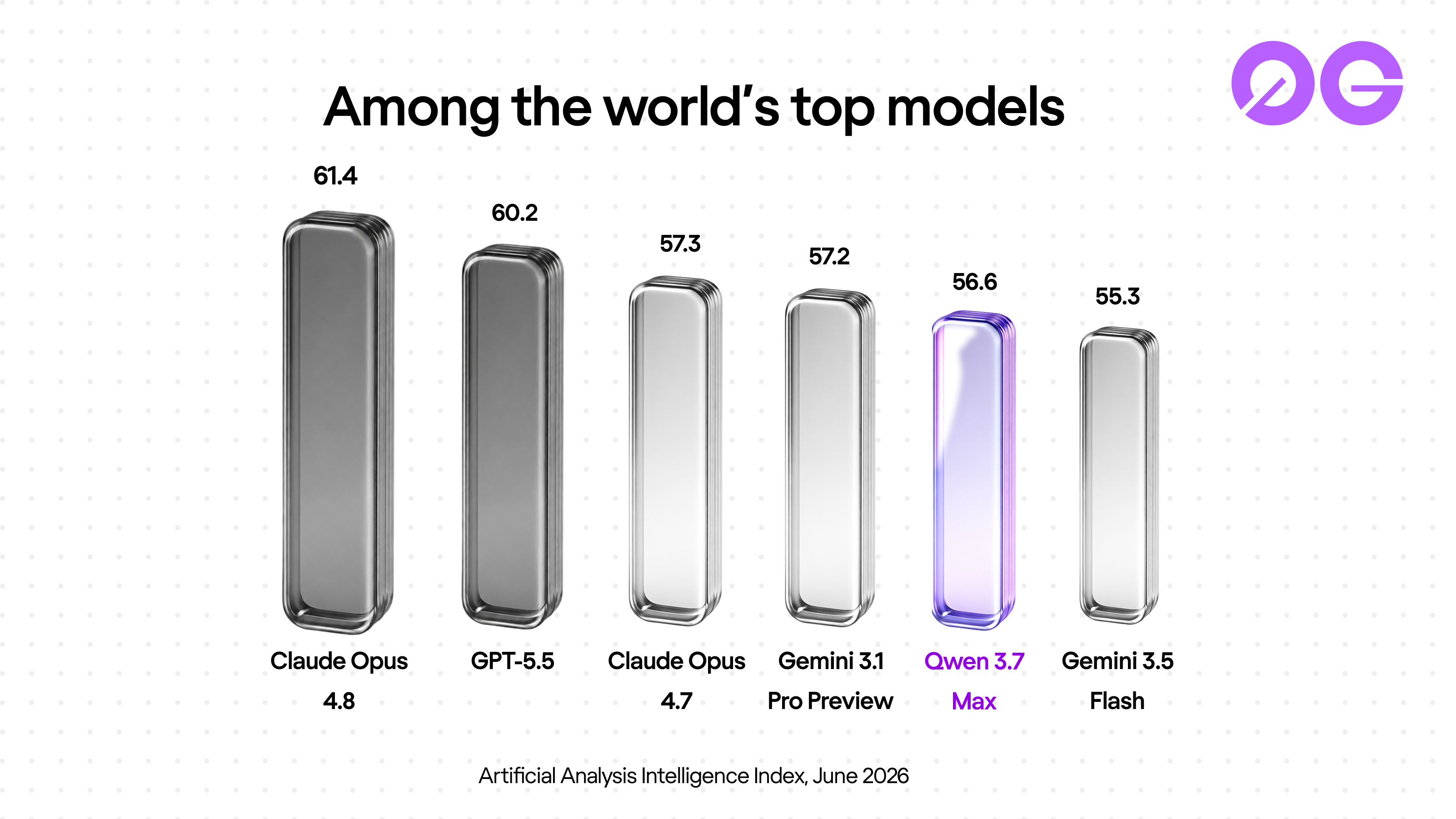
On the Artificial Analysis Intelligence Index, Qwen 3.7 Max scores 56.6, fifth overall (June 2026). Alibaba reports task-level results of 60.6 on SWE-Bench Pro, 69.7 on Terminal-Bench 2.0-Terminus, and 92.4 on GPQA Diamond. On the more autonomous end, Alibaba reports a single agent run of roughly 35 hours across more than 1,000 consecutive tool calls on an internal kernel-optimization task. These autonomy figures represent Alibaba's internal testing capabilities and showcase the model's theoretical limits on long-horizon tasks.
How 0G serves Qwen 3.7 Max: TeeTLS-attested routing
Qwen 3.7 Max is closed-weight and API-only. 0G does not host or run its inference, and the deployment never pretends otherwise. The model runs on Alibaba Cloud Model Studio. What 0G adds is a verifiable routing layer.
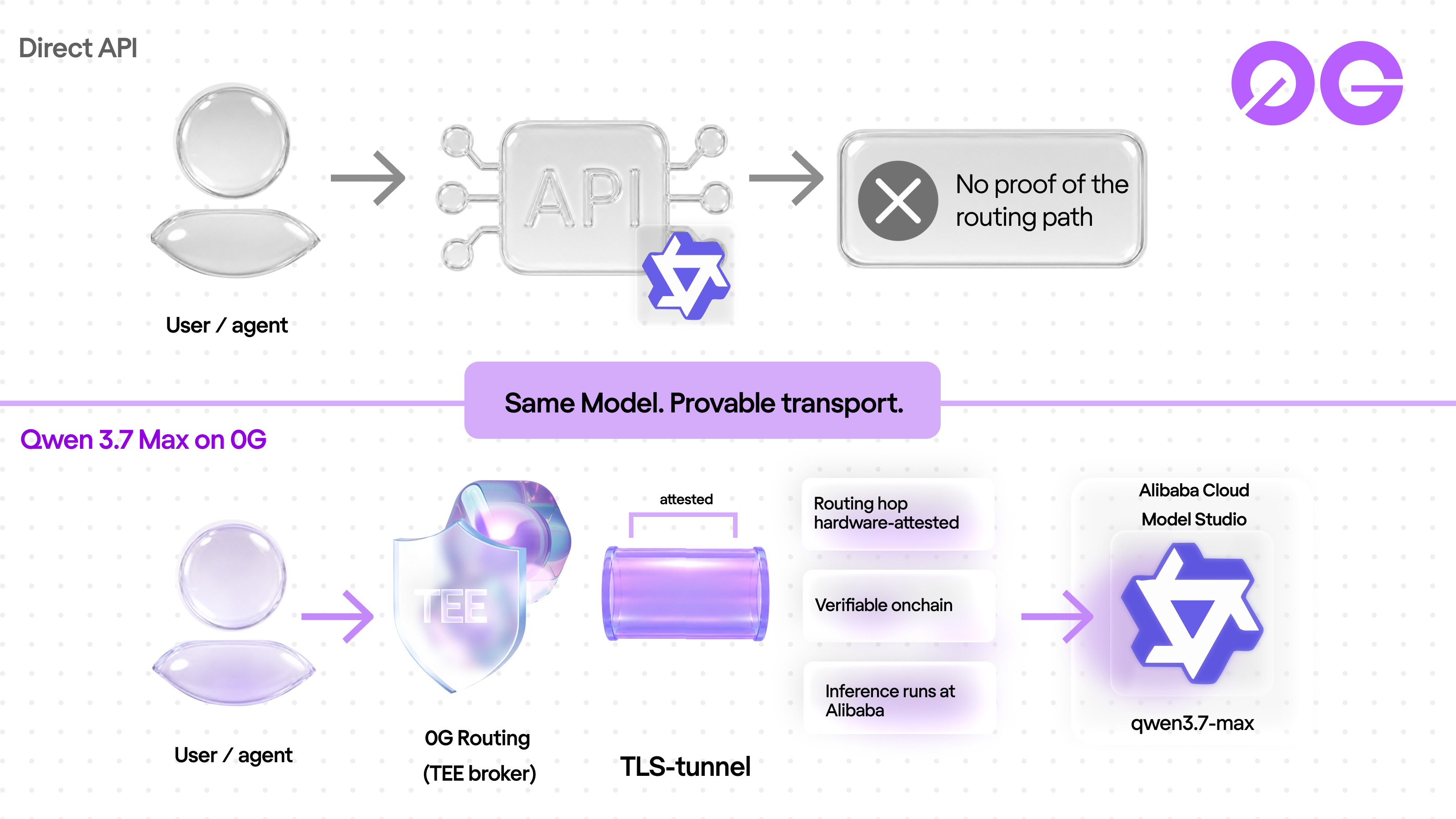
The 0G Private Computer exposes two trust models on one key flow. TeeML is the sovereign tier: the model runs inside a TEE-sealed enclave that 0G operates, and the operator cannot read the prompt. 0GM-1.0 uses this. TeeTLS is the verifiable-frontier tier: a broker runs inside a TEE and proxies your request to a centralized provider over HTTPS. The TLS handshake to the upstream runs inside that enclave, so hardware proves the routing cannot be intercepted or silently redirected. The inference happens at the upstream. Qwen 3.7 Max uses TeeTLS; the upstream is Alibaba Cloud Model Studio.
That is a smaller-scope guarantee than full enclave inference, and it is the honest one for a closed-weight model that only its maker can host. 0G does not claim to run Qwen's inference. It attests the path your prompt takes to Alibaba, and proves onchain which upstream received it and how the transport was protected. Every provider on the 0G Compute Network is verified by the 0G team before it is listed. It is the same shape as DeepSeek V4 Pro on 0G, the verifiable-frontier companion to 0GM-1.0's sovereign tier.
What 0G adds over a direct API
A direct call to a centralized model API gives you the model and nothing else. You cannot prove where the prompt went, what protected it in transit, or that it reached the endpoint you intended. For a human in a dashboard that gap is usually acceptable. For an autonomous agent that runs unattended and handles proprietary code, user data, or value, it is the part that does not scale.
The 0G deployment closes that gap without changing the model. You still talk to Qwen 3.7 Max. The difference is that the routing is hardware-attested and recorded onchain, so an agent, or whoever audits it later, can verify the transport rather than assume it. This is what "the Blockchain for AI Agents" means in practice: the intelligence stays with the model maker, and the trust layer becomes something you can check.
Build with it
Existing OpenAI-compatible client code runs against the 0G deployment with one base URL change.
from openai import OpenAI

client = OpenAI(base_url="https://router-api.0g.ai/v1", api_key="app-sk-<YOUR_KEY>")
response = client.chat.completions.create(
    model="qwen3.7-max",
    messages=[{"role": "user", "content": "Plan a three-step refactor of this module."}],
)
print(response.choices[0].message.content)
Native function calling works end-to-end: send an OpenAI tools=[...] payload and the response returns a proper tool_calls array. Extended thinking is on by default, so responses include a reasoning trace alongside the answer. For providers running inside a TEE, you can request onchain signature verification so the routing attestation surfaces in the response trace. Router Mode picks the model for you; Advanced Mode lets you target qwen3.7-max directly.
Pricing in $0G
Usage is USD-denominated and settled on 0G Chain, hourly FX-pegged to $0G. Qwen 3.7 Max is priced at 2.60 $0G per million input tokens and 7.81 $0G per million output tokens, with cached input at 0.52 $0G per million. That tracks in line with what you would pay reaching the model through other API providers; the deployment exists for the verifiable, private routing on top, not for a price advantage. For workloads that legally cannot send prompts to a centralized endpoint without proof of the routing path, that is the reason it is here.
Frequently asked questions
Does 0G host or run Qwen 3.7 Max's inference?
No. Alibaba Cloud Model Studio runs the model. 0G's contribution is a TeeTLS-attested routing layer that proves onchain which upstream your prompt was sent to and how the transport was protected. The model stays with Alibaba; the verifiable routing is 0G's.
How is querying Qwen 3.7 Max on 0G different from using a centralized API?
A direct API gives you the model with no proof of where your prompt went. The 0G deployment routes through a TEE-sealed broker to Alibaba Cloud Model Studio and records the routing onchain, so an agent or an auditor can verify the transport instead of trusting it by policy. Same model, provable path.
Which Qwen models are live on 0G?
Qwen 3.7 Max, the newest flagship, and Qwen 3.6-Plus, which arrived with the earlier Alibaba Cloud collaboration. They are separate deployments on the same key flow. This post covers Qwen 3.7 Max.
Is this the same as the Alibaba Cloud x Qwen partnership?
No. That announcement brought the Qwen family onchain for AI agents and centered on Qwen 3.6-Plus. This is a separate, later beat: the newest Qwen flagship, Qwen 3.7 Max, made queryable on 0G private compute. It builds on the partnership rather than repeating it.
What is 0G?
0G is the trust layer for AI. It combines private compute, encrypted storage, and an AI-native EVM L1 chain in one stack where AI work, from inference to agent actions, is verified and audited.
Where can I get 0G?
get.0g.ai is the interactive guide on how and where to acquire 0G tokens, with options for developers, investors, and ecosystem participants.
Where can I build on 0G?
Start with the 0G documentation, then query Qwen 3.7 Max directly at pc.0g.ai.
Build on 0G
- Query Qwen 3.7 Max now: pc.0g.ai/models/qwen3.7-max
- Read the trust-model details: docs.0g.ai
- See the verifiable-frontier companion: DeepSeek V4 Pro on 0G
- Follow @0G_labs for what goes live next on 0G private compute
Sources:
- Qwen3.7: The Agent Frontier (Alibaba, model positioning and benchmarks)
- Artificial Analysis Intelligence Index, Qwen3.7-Max (Intelligence Index 56.6, #5, June 2026)
- 0G Compute Network inference docs (TeeML and TeeTLS definitions, app-sk key flow)
- DeepSeek V4 Pro is live on 0G (verifiable-frontier tier precedent)
- 0G Labs: Alibaba Cloud x Qwen onchain (the partnership this builds on)