Ghast AI brings OpenClaw-level AI power to a Chrome extension. One-click install, onchain memory, and tradable AI intelligence. Built on 0G.
Every AI assistant you have ever used lives on someone else's server.
Your prompts. Your preferences. Your private data. All flowing through infrastructure you do not control, protected by a terms-of-service agreement you did not read. If the service shuts down, your data goes with it. If you switch devices, you start from scratch.
Ghast AI changes this. It is a browser-native AI assistant that runs as a Chrome extension, stores your memory onchain through 0G Storage, and runs inference through 0G's decentralized Compute Network. No servers to configure. No API keys to manage. One click to install, under a minute to set up.
It is live on the Chrome Web Store.
The last-mile problem
AI assistants have become powerful. Getting them running has not kept up.
Tools like OpenClaw offer real capability: multi-model orchestration, tool integration, persistent memory systems. But they also require server setup, gateway configuration, API connections, and ongoing maintenance. For developers, this is a few hours of work. For everyone else, it is a wall they never get past. The AI works. Getting to the AI is the problem.
The centralized alternatives skip the setup problem but create a bigger one. OpenAI's Operator costs $200 per month and routes your data through OpenAI's servers. Google's Auto Browse locks you into Google's ecosystem. Both give you convenience. Neither gives you ownership of the intelligence your agent builds over time.
Even users who run their own setup face a second problem: data lock-in. Your AI learns your preferences, your workflows, your context. That knowledge lives on one device. Switch laptops, crash a hard drive, or change providers, and you lose months of accumulated intelligence.
The technology works. Delivery does not.
What Ghast AI actually is
Ghast AI is a Chrome extension. You install it from the Chrome Web Store, open your browser, and start working with an AI assistant that has 75+ built-in tools from day one. No tutorials. No documentation to read first. No servers to rent. The team built it around a simple test: if a non-technical user cannot set it up in 60 seconds, it is not ready.
The sidebar sits in your browser, context-aware and ready to act. It sees the page you are on, understands your workflow, and can execute across tools, not just answer questions.
Built by Songsu and Shuai, two Web3 builders with 4+ years of full-stack experience and winners of the 0G hackathon, Ghast AI was designed from day one to run on decentralized infrastructure. The team recently demoed the product at the AI Agents in Action summit at Hong Kong Cyberport.
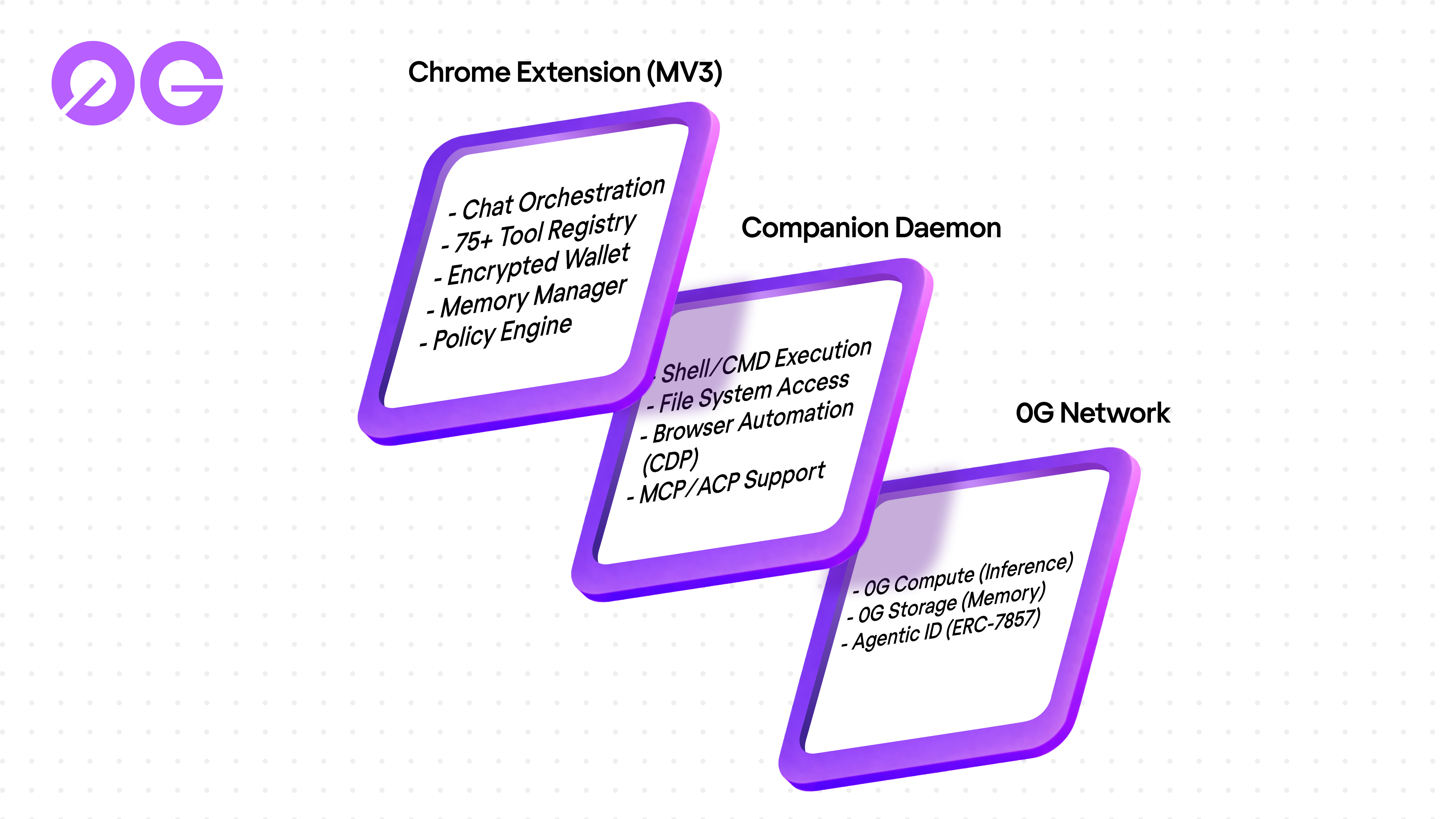
Under the hood, three layers work together:
Chrome Extension (MV3). The browser-native frontend handles chat orchestration, multi-model routing, a 75+ tool registry with risk-based gating, memory management, encrypted wallet management (AES-256-GCM), and a policy engine for transaction risk control.
Companion Daemon. A local desktop service extends what the extension can do: shell command execution, file system access, Chrome DevTools Protocol automation, and MCP/ACP protocol support. Communication stays on localhost with token authentication. No ports exposed to the internet.
0G Network. Decentralized infrastructure provides model inference (0G Compute), encrypted storage (0G Storage), onchain memory checkpoints, and the foundation for Agentic ID minting based on ERC-7857.
No server rental. No Docker containers. No SSH keys. Install the extension, connect the companion, and the full stack is running.
Memory that lives onchain
Most AI assistants treat memory as an afterthought. Ghast AI treats it as the product.
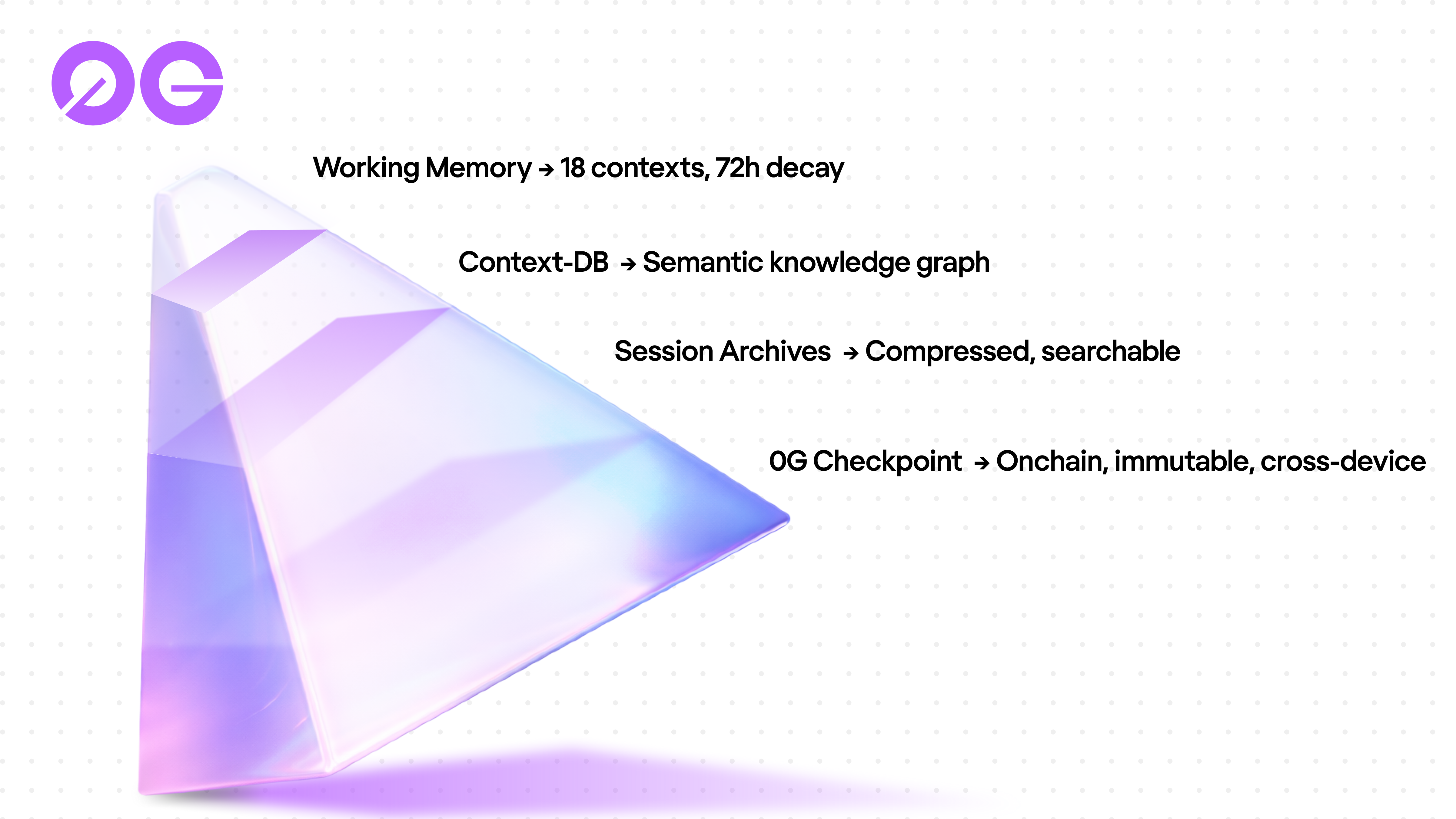
The memory system has four layers:
L1: Working Memory. 18 active contexts with a 72-hour attention decay. This is what your AI is thinking about right now. Real-time dialogue responses, sorted by importance, fading naturally as topics become less relevant.
L2: Context-DB. A semantic knowledge graph with URI namespaces. Three-layer retrieval (raw context, summaries, cross-references) builds a structured map of who you are and what you work on.
L3: Session Archives. Complete dialogue history, compressed and stored. Key memories are automatically promoted to long-term storage. Cross-session semantic retrieval lets your AI recall relevant context from weeks ago.
L4: 0G Checkpoint. Versioned snapshots stored onchain through 0G Storage. Immutable, encrypted, accessible from any device. This is the layer that solves portability. Switch browsers, switch machines, switch countries. Your AI remembers.
The L4 checkpoint is also the technical foundation for Agentic ID. Your accumulated AI intelligence, stored onchain, becomes an asset you own.
Privacy by architecture
Think about what your AI assistant knows: which pages you visit, what you type, which tokens you hold, which wallets you control. A compromised AI assistant is not a data breach. It is a skeleton key to your digital life. Security for an AI agent is not a feature checkbox. It is the foundation everything else sits on.
Ghast AI answers this structurally, not contractually:
TEE-based inference. Every model call through 0G Compute executes inside hardware-isolated Trusted Execution Environments. Your data stays encrypted during processing. Node operators cannot view or tamper with it. Responses are cryptographically signed.
Client-side wallet encryption. PBKDF2 key derivation plus AES-256-GCM means your wallet data never leaves your device unencrypted.
Memory encryption before storage. Data is encrypted on your machine before being pushed to 0G Storage. The platform cannot read the original content.
Transaction simulation before signing. Every onchain transaction is simulated first. You see the expected result before committing. A policy engine enforces per-transaction limits, daily budgets, and contract whitelists.
The difference between "we promise not to look" and "we physically cannot look."
The Phantom Wallet moment
When Phantom launched, Solana existed but felt inaccessible. The chain worked. Using it did not. Phantom put a wallet in the browser, made it intuitive, and the numbers followed: 1 million to over 3 million monthly active users within a year, peaking above 15 million by mid-2025. Over 24 million mobile downloads. More than $25 billion in self-custodied assets (TechCrunch, Coincub). A single gateway app defined the entire ecosystem.
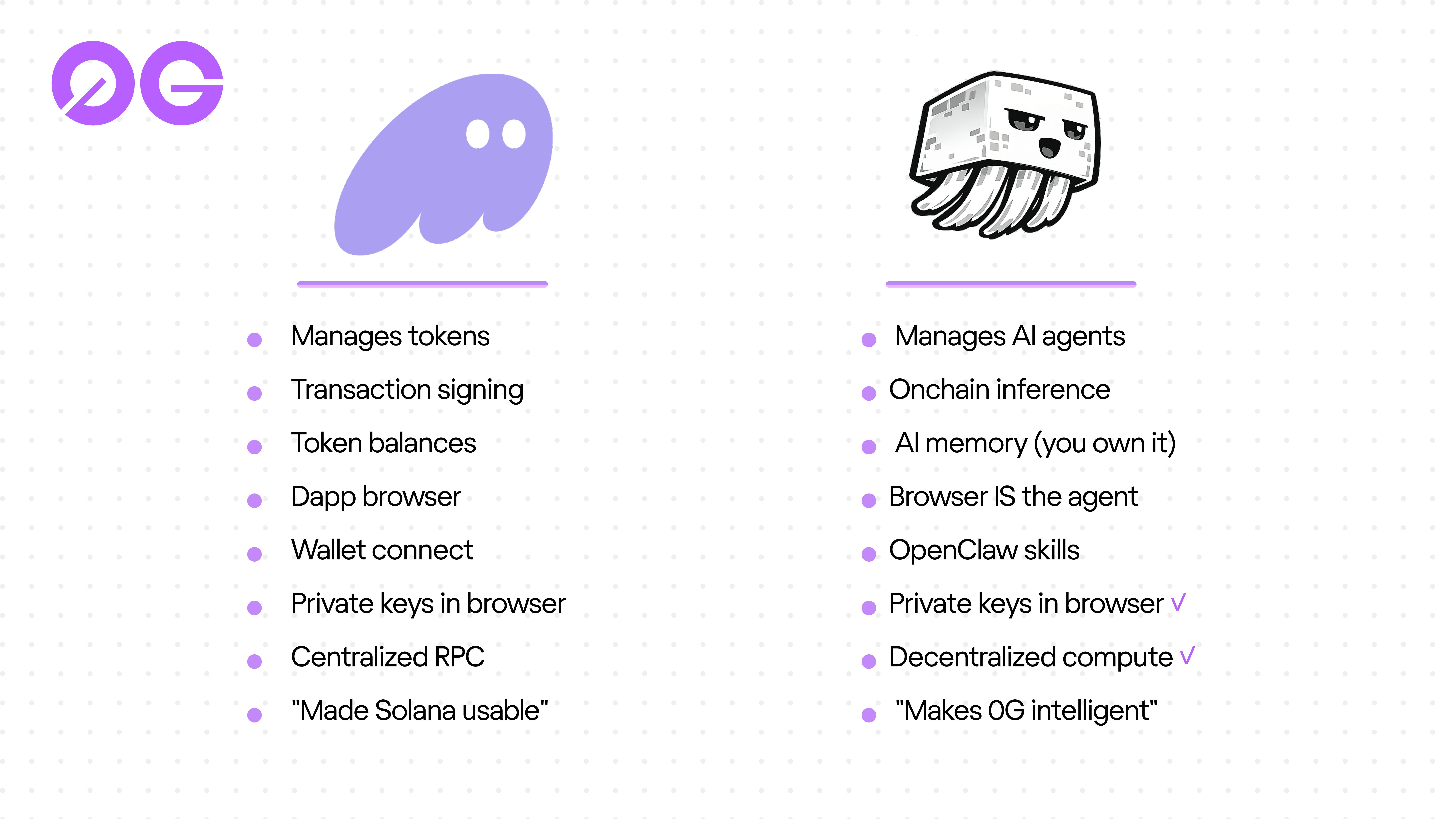
0G is at a similar point. The network has decentralized compute, storage, data availability, and a full chain. What it needs is a product that puts that stack into the hands of regular users.
Ghast AI is that product. It takes 0G's infrastructure and wraps it in something you install with one click. Users do not need to understand TEEs, storage nodes, or token standards. They install an extension. They get an AI assistant. Their data is private and their memory is persistent. The infrastructure does its job invisibly.
This is the first consumer-facing application built natively on the full 0G stack. It sits within 0G's broader product family alongside Zero Studio, CIB, and Bond. Ghast AI sets the tone for what "Blockchain for AI Agents" looks like when it reaches people who are not infrastructure engineers.
What comes next: Agentic ID and the creator economy
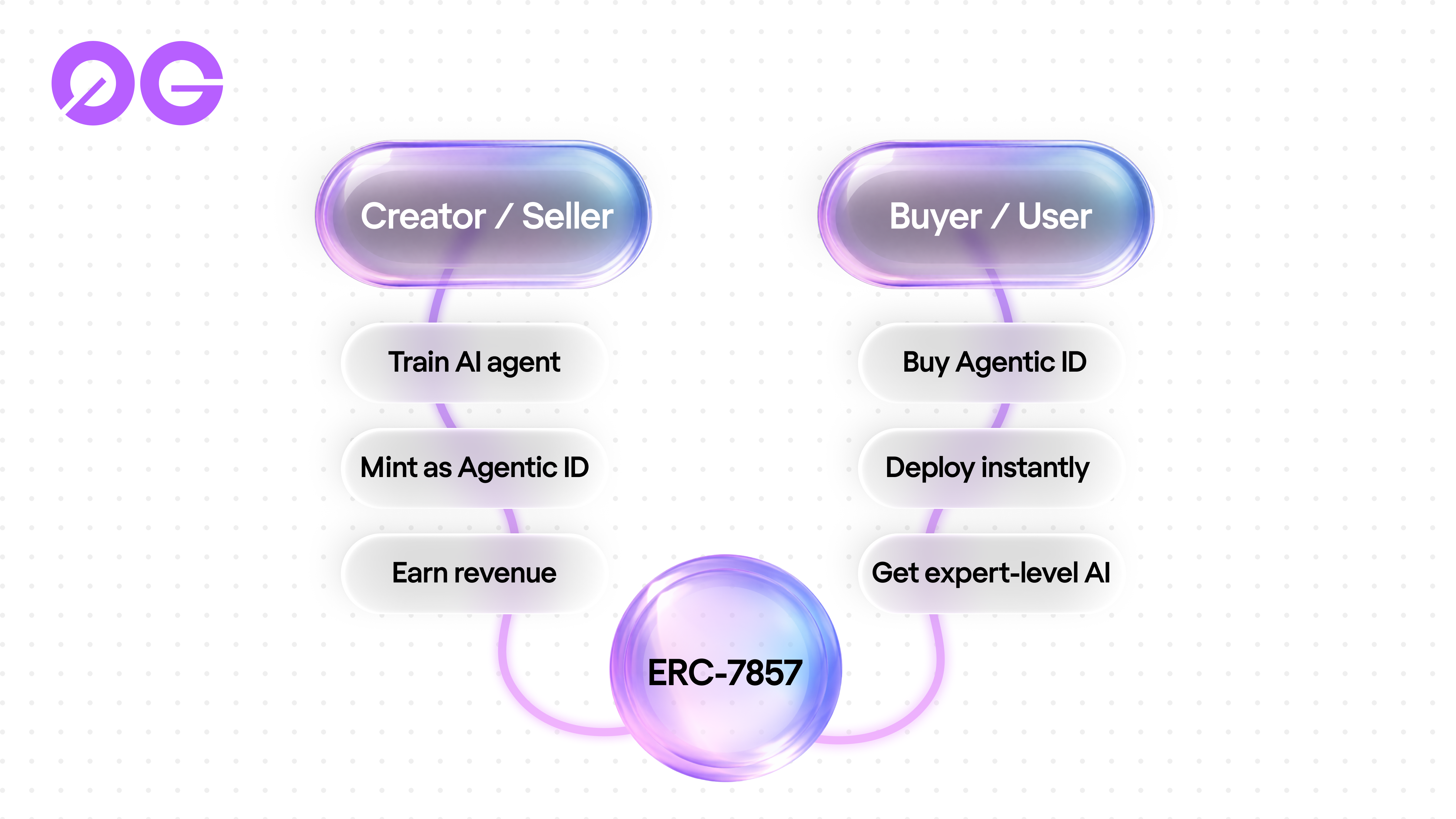
The most unusual feature on Ghast AI's roadmap is Agentic ID, built on 0G's ERC-7857 standard.
Your trained AI assistant, with its accumulated memory, personality, strategies, and capabilities, can be minted as an onchain asset. Unlike traditional NFTs that store a metadata pointer, an Agentic ID contains encrypted intelligence.
For buyers. Training a high-quality AI assistant from scratch costs time and money. A DeFi trading agent fine-tuned over months of market data could be purchased as an Agentic ID and deployed instantly.
For creators. AI training specialists package their work as Agentic IDs and sell them. Training becomes revenue, not just cost.
For the ecosystem. Intelligence becomes transferable. It can be sold, licensed, or delegated.
Alongside Agentic ID, a Workflow Template Store is planned: pre-built automation templates (DeFi auto-harvest, Twitter monitoring, onchain whale alerts) that users install with one click and customize. Creators earn the majority of revenue on templates they publish.
Agentic ID minting and the trading marketplace are in Phase 2 of Ghast AI's roadmap. The foundation, the L4 onchain checkpoint and ERC-7857 standard, is already in place.
Getting started
Ghast AI is live on the Chrome Web Store.
- Install the extension from the Chrome Web Store.
- Set up in under a minute. No server, no API keys, no configuration files.
- Join the community. Early adopter campaign with access codes and exclusive roles on Discord and Telegram.
- Follow development. @Ghast_AI on X for product updates.
The pre-alpha has passed 1,200 registered users. 863 of them actively recharge tokens to use the product. Over 56 million inference tokens consumed. Daily active users have nearly quadrupled over the past ten days. Retention climbed from 10% to 26% in the same window. People are not just trying it. They are coming back.
The agent economy needs more than infrastructure. It needs products people can actually use. Ghast AI is the first one built on 0G that puts the full stack in your browser.
Install it. Train it. Own what it learns.
This post is for informational purposes only. It does not constitute financial advice. Always do your own research before interacting with any protocol or token.